
One successful resin trial does not prove supplier reliability. A material may perform well in one trial, but supplier qualification needs to go beyond technical fit. Supply continuity, batch consistency, technical support, delivery performance, total cost and future scalability all need to be considered before approving a new resin supplier.
Choosing a resin supplier based on a successful trial or a competitive ₹/kg price can leave important risks unchecked. A stronger qualification process looks at whether the supplier can maintain reliable supply, deliver consistent material across batches, support production issues, meet JIT delivery requirements and provide a realistic total-cost advantage. It should also consider whether the supplier can support changing requirements as volumes, grades and applications grow. These six areas provide a practical framework for evaluating a resin supplier beyond the initial sample or quoted price.
A supplier may deliver successfully once, but the more important consideration is whether they can protect your supply when availability tightens.
Before approving a supplier, check whether there is direct manufacturer authorization or a documented sourcing route. Confirm whether they can provide supply or allocation support, and understand whether they can maintain grade continuity while providing advance notice of material changes.
A successful trial establishes technical fit. Reliable supply protects the production plan.
A datasheet provides target values, but it does not show how every production lot performs. Batch-to-batch consistency therefore needs to be evaluated separately.
Ask for multiple consecutive batch COAs (Certificates of Analysis) rather than relying on a single document. Review the available information for MFI/MFR or viscosity, density and moisture, mechanical properties, and colour/additive consistency.
The goal is not simply to confirm that one batch meets the expected values. The qualification process should examine whether those characteristics remain consistent across consecutive batches.
Never sign off on a single COA alone.
A resin supplier's role should not end when the material reaches the production floor. When parts warp or rejection rates increase, technical support becomes an important part of supplier evaluation.
Assess whether the supplier can provide processing guidance and optimization, help with the diagnosis of material- or process-related defects, and provide troubleshooting support during production trials.
This distinction matters when evaluating a supplier: technical capability needs to extend beyond having a supplier contact. Strong technical support can reduce production risk.
A low resin quote has limited value if your machines are waiting for material. Delivery performance should therefore be part of supplier qualification rather than an assumption made after approval.
Verify the supplier's standard and emergency lead times. Check whether local warehousing or safety-stock options are available, and review their track record of on-time, complete deliveries.
The objective is predictable supply that supports the production plan, including when material is needed within a JIT delivery model.
A lower resin price can disappear quickly when other costs increase. Looking only at the quoted ₹/kg can therefore miss important elements of the overall cost.
When comparing suppliers, factor in MOQ and payment terms, as well as freight, handling and packaging. Also consider processing efficiency, scrap and rejection.
A resin that appears cheaper at the purchase stage may not remain cheaper if higher rejection or downtime increases the overall cost. The right comparison is therefore broader than the initial material price.
Supplier requirements can change as your business grows. A supplier that works for today's requirements also needs to be evaluated against what may be required at the next stage.
Ask whether the supplier can handle higher volumes. Assess whether they can support new grades and applications. Review whether they can meet audit requirements, and understand whether they will provide notification before material or process changes.
These considerations help determine whether you are qualifying a supplier for the current requirement or a partner capable of supporting the next stage of growth.
Taken together, these six areas create a broader qualification framework:
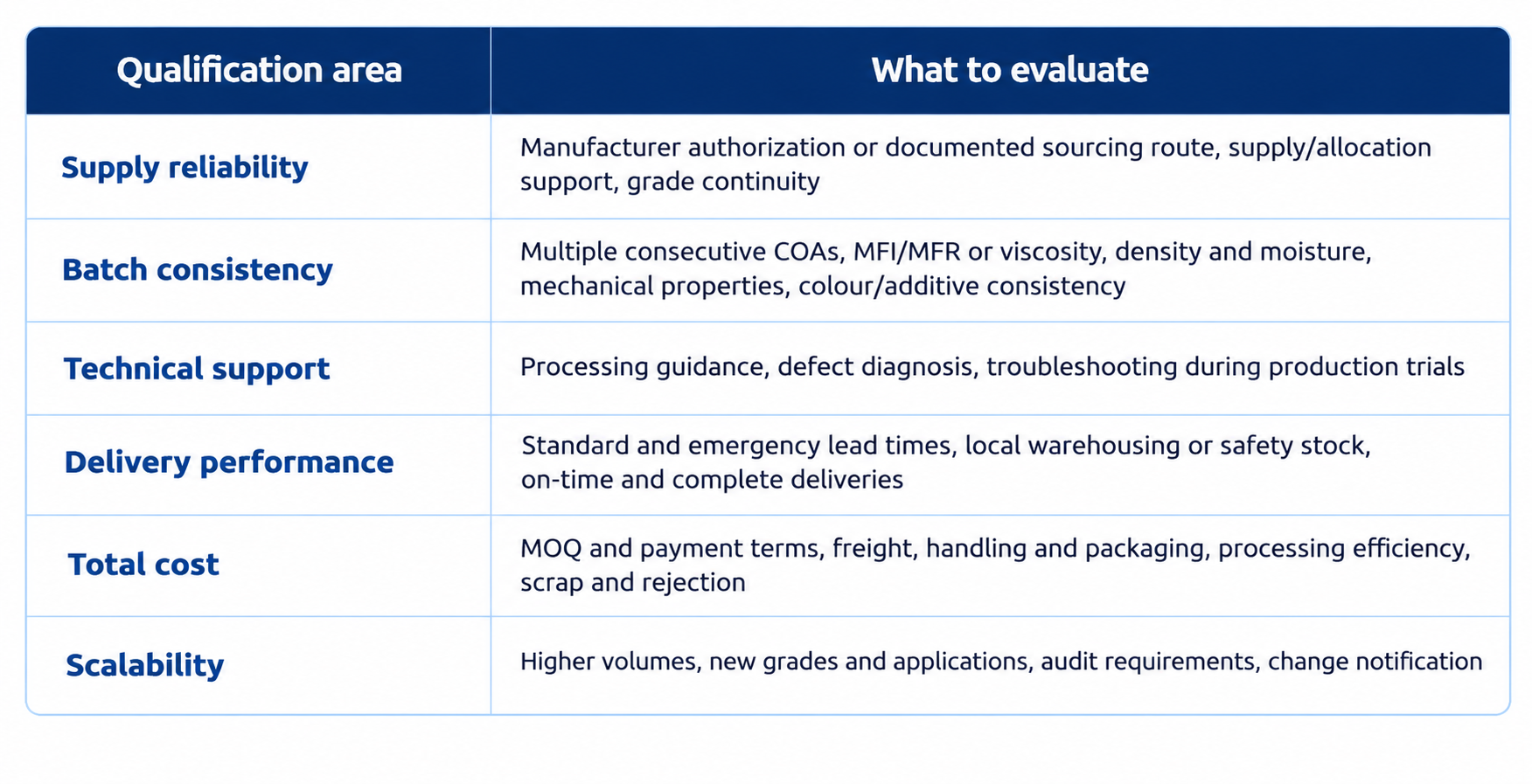
A resin supplier should therefore be evaluated on more than whether the material passed one trial or whether the quoted price is competitive.
No. One successful trial demonstrates technical fit, but supplier qualification should also consider supply reliability, batch consistency, technical support, delivery performance, total cost and scalability.
Multiple consecutive batch COAs can be reviewed for MFI/MFR or viscosity, density and moisture, mechanical properties, and colour/additive consistency.
The qualification process should assess support for processing guidance and optimization, diagnosis of material- or process-related defects, and troubleshooting during production trials.
Verify standard and emergency lead times, local warehousing or safety-stock options, and the supplier's track record of on-time, complete deliveries.
Because freight, handling, packaging, processing efficiency, scrap and rejection can affect the overall cost. A cheaper resin with higher rejection or downtime can cost more.
Evaluate whether the supplier can handle higher volumes, support new grades and applications, meet audit requirements and notify you before material or process changes.
Need a resin partner for your next stage of growth? Contact us for a free consultation.
Email: polymers@distil.market
READ MORE


READ MORE
READ MORE
READ MORE
READ MORE
READ MORE
READ MORE
READ MORE
READ MORE

READ MORE
READ MORE

READ MORE
READ MORE
READ MORE

READ MORE

We enable global brands to diversify production and accelerate sustainable sourcing while protecting IP.
Corporate Presentation
Follow us


© 2026 Distil. All rights reserved.


