
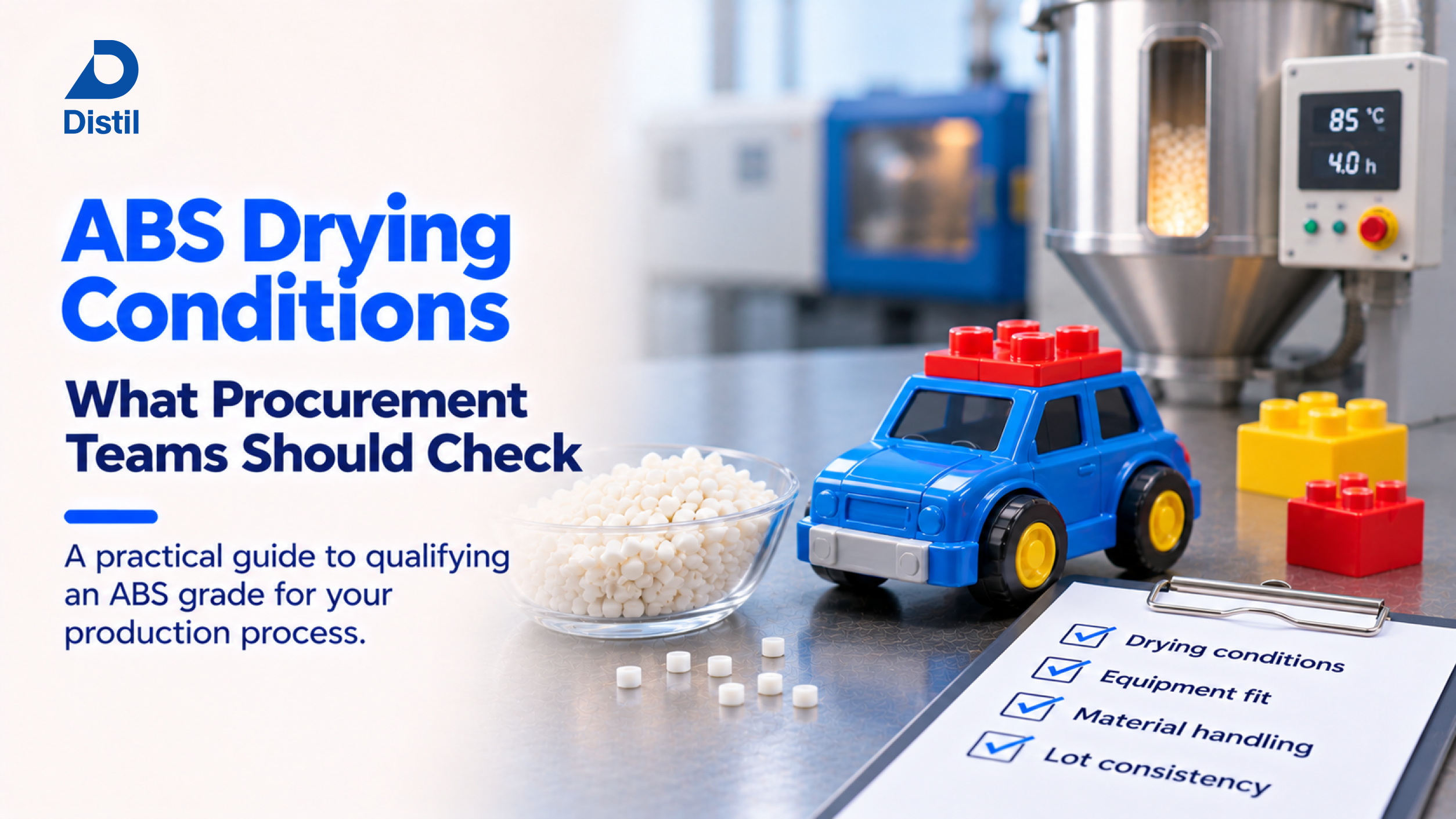
An ABS grade can meet every datasheet requirement and still create moulding problems if its drying requirements do not fit the plant's process. For procurement teams qualifying a new ABS grade, drying should therefore be evaluated as part of material qualification—not treated only as a production adjustment after approval.
ABS grades can differ in their recommended drying temperature, drying time and allowable moisture level. Before moulding, procurement and engineering teams should verify the supplier's grade-specific drying requirements and confirm that the existing dryer and hopper system can consistently achieve them.
Poor moisture control can contribute to surface defects such as splay and silver streaks, inconsistent appearance and increased scrap. Drying conditions that fall outside the supplier's recommended range can also contribute to discoloration or material degradation.
Qualification should therefore consider more than resin price and datasheet properties. Packaging, storage, drying equipment, throughput, incoming lot consistency and multi-lot trial performance all contribute to the material's overall process fit.
ABS pellets can absorb moisture from ambient conditions, particularly when packaging is opened and the material is exposed to humid air for extended periods.
If moisture is too high during injection moulding, it can contribute to defects such as:
At the same time, drying outside the supplier's recommended conditions—particularly excessive temperature or unnecessarily long residence time—can contribute to discoloration or material degradation.
For procurement teams, this creates an important qualification question:
Can the candidate ABS grade deliver consistent part quality using the drying and processing capabilities already available at the plant?
There is no single drying recipe that should be applied to every ABS grade.
Many ABS processing guides use drying temperatures around 80–90°C, with drying times commonly falling in the 2–5 hour range. Recommended moisture limits can also vary by grade and supplier. Some published ABS processing guidance specifies moisture below 0.05%, while other grades use 0.1% as a recommended limit.
These values should therefore be treated as typical reference ranges, not universal specifications.
For every candidate grade, verify:
The supplier's technical datasheet or processing guide should take precedence over generic ABS drying ranges.
A lower resin price may not deliver a lower conversion cost if the grade requires drying conditions that the existing production setup cannot maintain consistently.
Before approving a new ABS grade, review the drying system with plant engineering:
Can the dryer reliably maintain the required temperature, airflow and drying-air conditions?
For dehumidifying systems, also check whether the dryer can maintain the required air dew point when specified by the material supplier.
Can the dryer support the planned moulding throughput without shortening the required drying cycle?
Does the hopper provide sufficient residence time at the recommended conditions without unnecessarily long exposure to heat?
Can the system maintain consistent drying performance across shifts, production loads and changes in ambient humidity?
The objective is simple:
Material fit + equipment fit = more reliable production.
Drying requirements are influenced by how much moisture the resin has picked up before it reaches the dryer.
Procurement and production teams should evaluate four areas:
Check whether the supplier's packaging provides adequate moisture protection and remains properly sealed during transportation and storage.
Verify that resin is stored according to the supplier's recommendations and protected from prolonged exposure to humid conditions.
Also consider temperature changes during handling. If cold resin is moved into a warmer processing environment, allowing the sealed package to reach room temperature before opening can help reduce the risk of condensation.
Compare moisture measurements across multiple shipments rather than judging a supplier from a single lot.
Define how quickly opened bags or bulk containers should be consumed or resealed to limit moisture pickup before processing.
Drying can also affect the economics of material selection.
When comparing alternative ABS grades, consider:
A grade with a lower purchase price may not have the lowest overall conversion cost if it requires additional drying capacity, longer drying cycles or generates more process variation.
₹/kg is only one part of the material cost equation.
A successful single-lot trial demonstrates performance under that trial's conditions. It does not establish supplier or lot-to-lot consistency.
For qualification, evaluate the candidate ABS grade across multiple lots through the complete process:
Incoming material → Drying → Moulding → Finished parts
Monitor splay, silver streaks, colour consistency, surface gloss and other appearance requirements relevant to the part.
Compare drying response, melt consistency, cycle repeatability and overall process stability.
Evaluate the properties that matter for the application, such as impact strength, dimensional stability or functional performance defined by the part specification.
Track rejection rates and identify whether defects are associated with moisture, drying conditions or other processing variables.
This approach helps distinguish a material problem from a process problem before the grade is approved for regular production.
Confirm the supplier's recommended drying temperature, drying time and moisture limit before moulding.
Verify dryer capability, drying capacity, hopper capacity and the ability to maintain required conditions on the target production line.
Check moisture protection during transportation, warehouse storage and post-opening handling.
Compare moisture and processing behaviour across multiple incoming lots rather than relying on a single shipment.
Evaluate the material from incoming resin through drying, moulding and finished parts, including appearance, processing behaviour, key part properties and scrap.
Before approving an alternative ABS grade, ask the supplier for:
Having these details before qualification helps procurement and engineering teams identify process-fit issues before the material reaches regular production.
No. Recommended temperature, drying time and moisture limits can vary by grade and supplier. Always use the grade-specific technical datasheet or processing guide as the primary reference.
Drying can directly affect moulding quality, appearance, scrap and process consistency. A grade may perform well on paper but still create production issues if the plant cannot consistently meet its recommended drying conditions.
Review dryer capability, drying capacity, hopper capacity, residence time and the ability to maintain the required drying conditions consistently.
Yes. Packaging condition, storage and post-opening handling influence how much moisture the resin can pick up before moulding.
No. A single successful trial does not establish lot-to-lot consistency. Multi-lot trials provide stronger evidence of repeatable material and process performance.
Track the material from incoming condition through drying and moulding to finished parts. Evaluate appearance, processing behaviour, application-specific part properties and scrap or rejection.
Talk to Distil for polymer alternatives, technical evaluation and structured trial support.
For formulation details, reach out to polymers@distil.market
READ MORE


READ MORE
READ MORE
READ MORE
READ MORE
READ MORE
READ MORE
READ MORE
READ MORE
READ MORE
READ MORE
READ MORE

READ MORE
READ MORE
READ MORE
READ MORE
READ MORE
READ MORE
READ MORE
READ MORE
READ MORE
READ MORE
READ MORE
READ MORE
READ MORE

READ MORE

We enable global brands to diversify production and accelerate sustainable sourcing while protecting IP.
Corporate Presentation
Follow us


© 2026 Distil. All rights reserved.


