
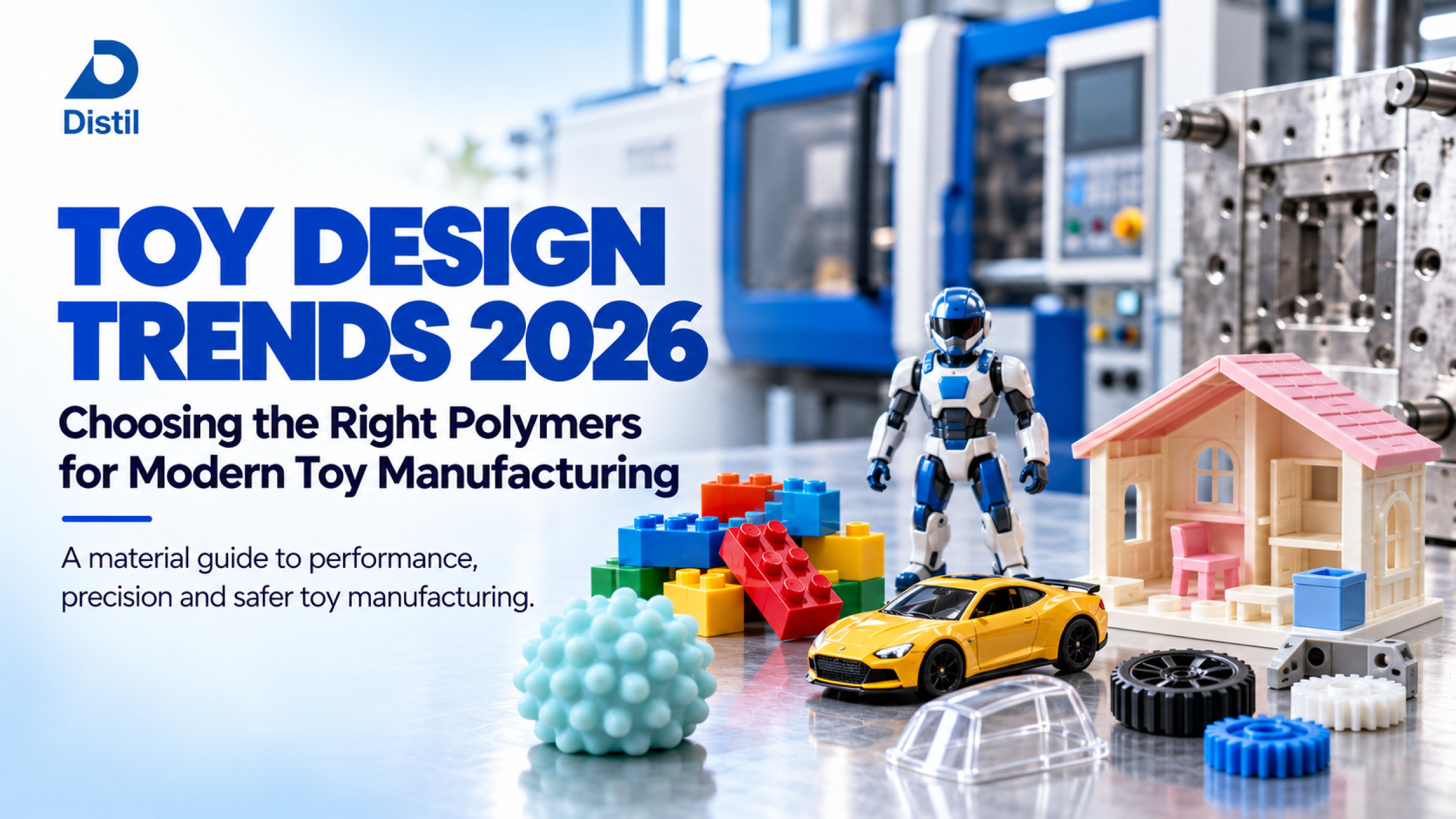
Matching the right polymer to a toy component starts with understanding what the part needs to do. An exterior housing may prioritize impact resistance, surface appearance and dimensional control, while an internal clip or hinged component may need repeated flexing without cracking.
ABS, PP and HIPS are widely used thermoplastics in toy manufacturing, but they offer different combinations of rigidity, toughness, flexibility, surface characteristics and processing behavior.
The right choice should therefore go beyond resin price. Part geometry, wall thickness, molding conditions, assembly requirements, decoration methods and the performance required from the finished component all influence grade selection.
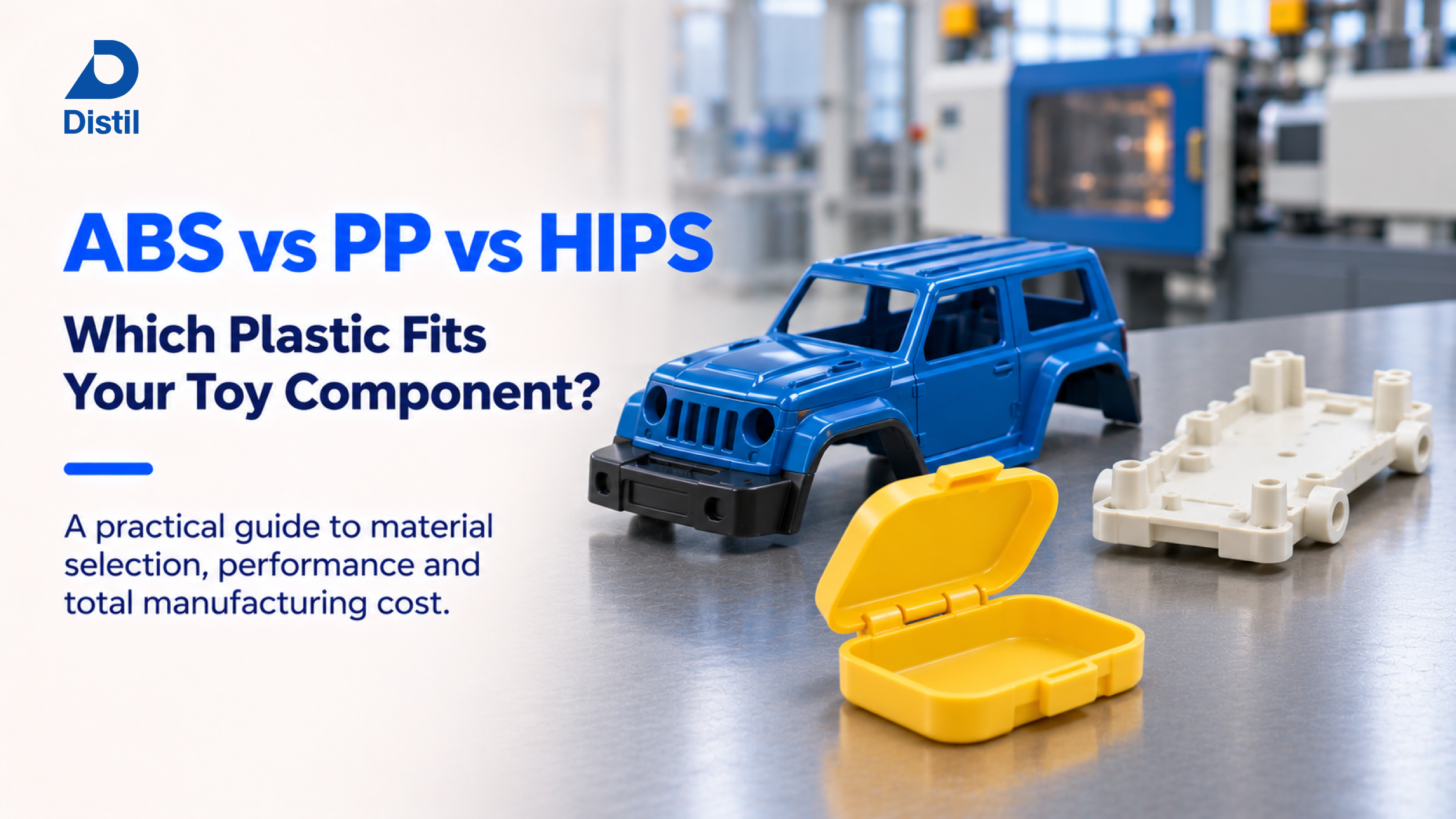
ABS, PP and HIPS each have a practical role in toy manufacturing:
Before comparing polymer grades, evaluate the component across four practical areas:
Can the part withstand drops, handling and assembly loads without cracking or excessive damage?
Does the component need to bend repeatedly, snap into place or function as a living hinge?
Will the part be painted, pad-printed, plated, bonded or welded? If so, does the selected grade support the required finishing process?
How tightly must the component fit with mating parts? How will molding shrinkage, warpage and processing conditions affect the final dimensions?
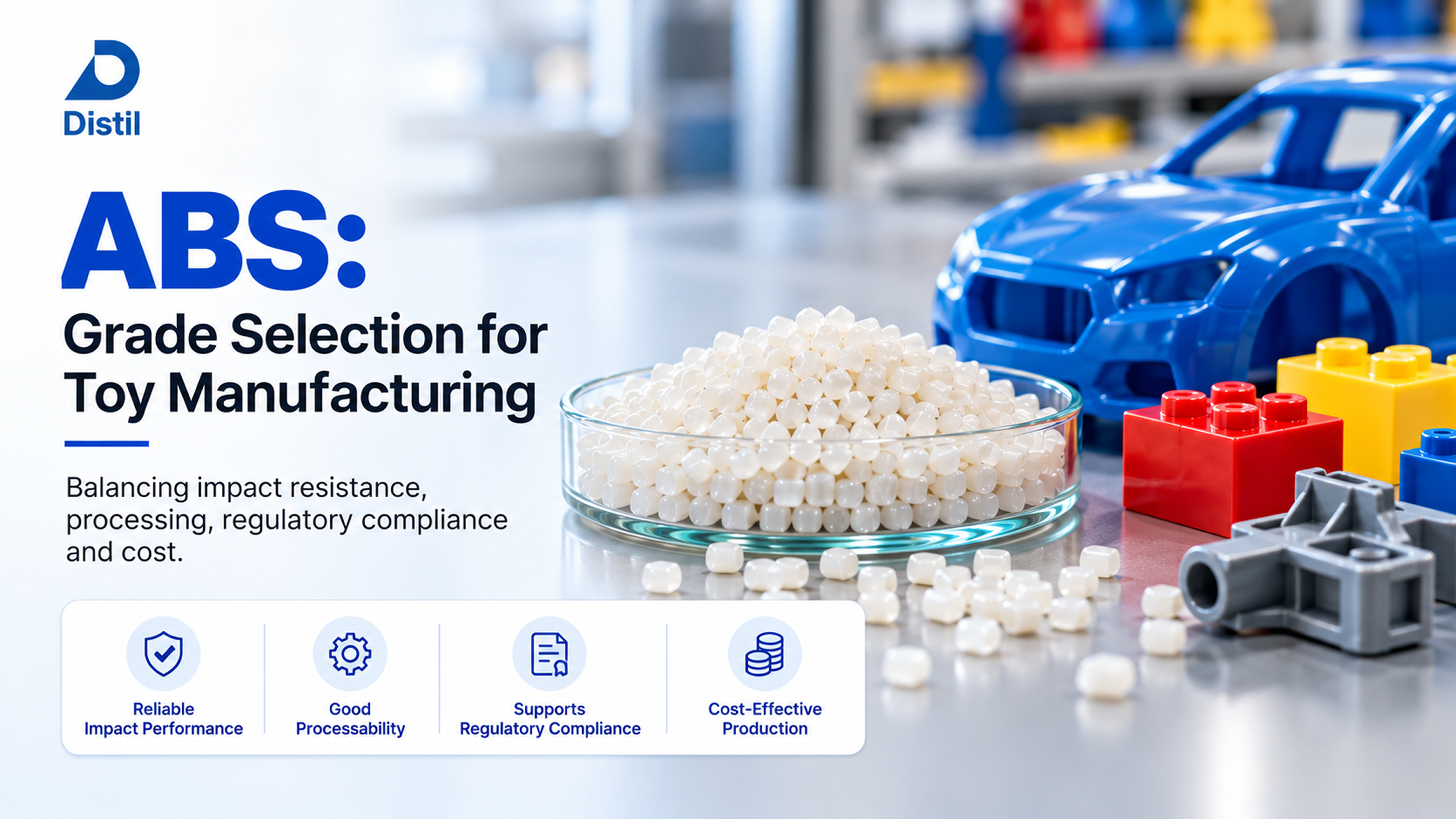
ABS (Acrylonitrile Butadiene Styrene) is commonly used for rigid toy components where toughness, surface appearance and dimensional control are important.
Detailed vehicle bodies, action-figure components, rigid housings, decorative exterior parts and components requiring a combination of toughness and surface quality.
PP (Polypropylene) is widely used when low density, flexibility and repeated flexing are important. Its fatigue resistance makes it particularly useful for living hinges and repeatedly flexed components.
Living-hinge lids, flexible clips, snap-fit components, lightweight parts and components requiring repeated flexing.
HIPS (High Impact Polystyrene) is a rubber-modified polystyrene designed to provide greater toughness than general-purpose polystyrene while retaining relatively straightforward processing.
HIPS generally provides lower impact performance than many ABS grades, so it may be less suitable for highly impact-loaded exterior components. Outdoor applications may also require a specifically stabilized grade when UV exposure is expected.
Internal chassis plates, battery compartment covers, opaque accessories and other rigid, cost-sensitive components operating under moderate mechanical stress.
Component requirementRecommended starting pointKey reasonDetailed vehicle shellABSGood combination of surface quality, toughness and dimensional controlLiving-hinge lid or claspPPStrong flex-fatigue performance when properly designedFlexible snap-fit clipPP / ABSPP for repeated flexing; ABS where greater rigidity is requiredInternal mounting plateHIPSRigid, easy to process and cost-effective for moderate loadsPainted exteriorABS / HIPSGenerally more straightforward to finish than low-surface-energy PPPlated exteriorPlating-grade ABSEstablished route for electroless and electroplating processes
These are starting-point material selections, not universal rules. Final grade selection depends on part geometry, wall thickness, required performance, melt flow, tooling and processing conditions.
The lowest resin price per kilogram does not always produce the lowest finished-part cost.
Before approving a material grade, evaluate the following:
Confirm that the specific resin grade, additives, colorants and masterbatch meet the requirements applicable to the finished toy and target market.
Depending on the market, this may include requirements associated with ASTM F963 in the US, EN 71 standards used for European toy compliance, or IS 9873 in India.
The relevant requirements depend on the finished product, intended age group, materials and market.
Material shrinkage affects tooling dimensions, part fit and dimensional consistency. ABS and HIPS generally have lower molding shrinkage than PP, but actual results depend on grade, geometry and processing conditions.
A material change should therefore be validated through molding trials rather than assumed to be a direct drop-in replacement.
Painting, printing, plating, bonding and welding can significantly affect total part cost.
For example, PP may require additional surface treatment or a compatible primer for certain coating or bonding applications, while specialized ABS grades are available for plating applications.
A lower-priced resin may not deliver the lowest cost per accepted part if it increases cycle time, warpage, dimensional variation or rejection rates.
The more useful metric is the total cost of producing an acceptable component, not simply ₹/kg.
Often, yes. Both are amorphous styrenic materials with relatively low molding shrinkage, so the same basic tool concept may sometimes be used for comparative trials. However, differences in melt flow, processing conditions, filling behavior and final part performance mean that a controlled molding trial is still necessary.
ABS and HIPS generally offer more straightforward surface finishing and bonding than PP. PP has low surface energy, so painting and adhesive bonding may require surface treatment, a compatible primer or a specialized adhesive system.
Yes. Different polymers can be used within the same toy when individual components have different functional requirements. For example, a toy vehicle could use ABS for the exterior body, HIPS for an internal chassis component and PP for a flexible clip or hinge.
Homopolymer PP is often preferred for demanding living-hinge applications because of its stiffness and hinge-fatigue performance. Copolymer PP grades can offer improved impact performance and may be preferred when toughness or low-temperature performance is more important. The final choice should consider hinge geometry, flex-cycle requirements and operating temperature.
Match your process and performance needs to the right resin grade.
For formulation details, reach out to polymers@distil.market.
READ MORE


READ MORE
READ MORE
READ MORE
READ MORE
READ MORE
READ MORE
READ MORE
READ MORE
READ MORE
READ MORE
READ MORE

READ MORE
READ MORE
READ MORE
READ MORE
READ MORE
READ MORE
READ MORE
READ MORE
READ MORE
READ MORE
READ MORE
READ MORE
READ MORE

READ MORE

We enable global brands to diversify production and accelerate sustainable sourcing while protecting IP.
Corporate Presentation
Follow us


© 2026 Distil. All rights reserved.


