
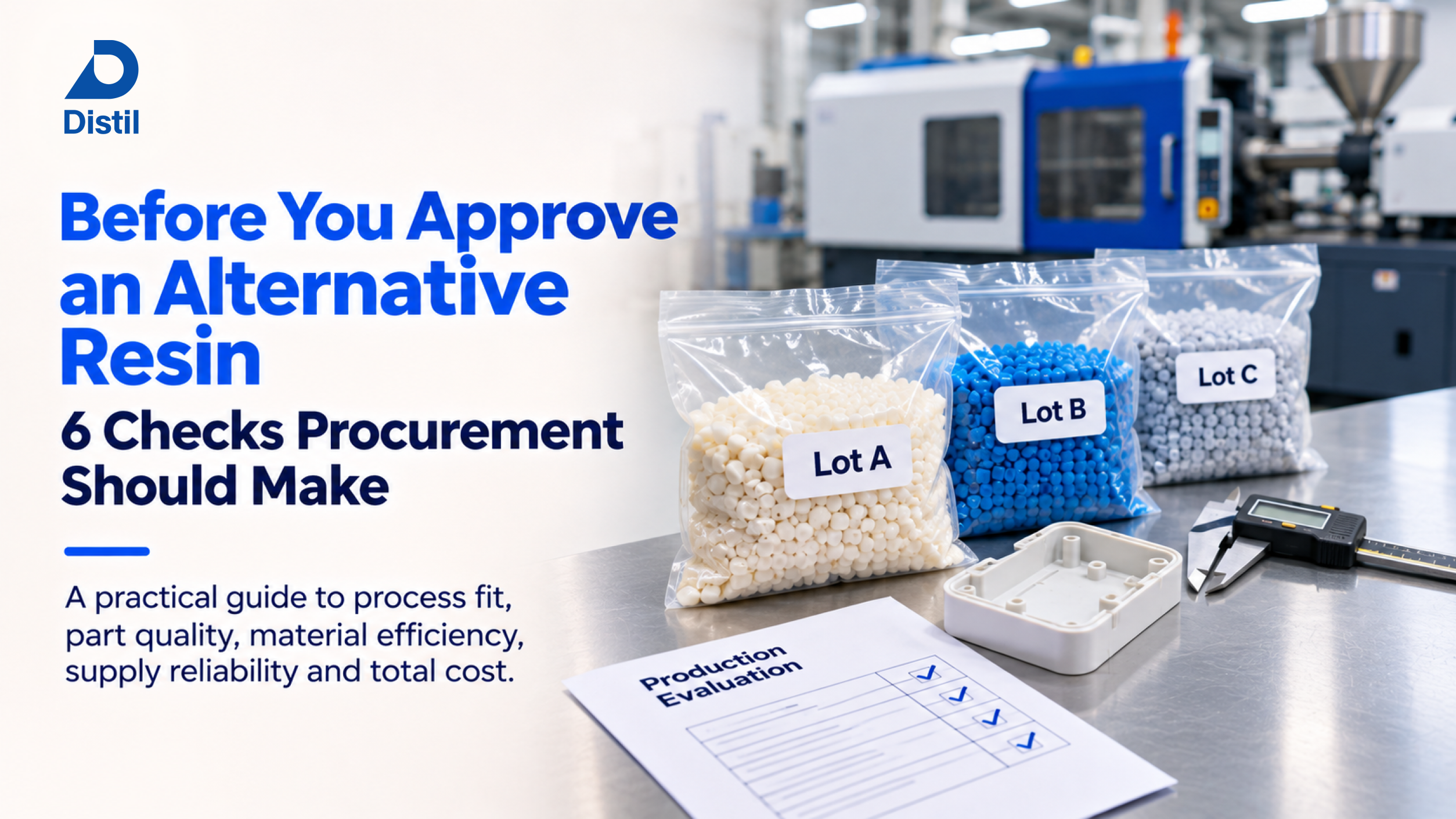
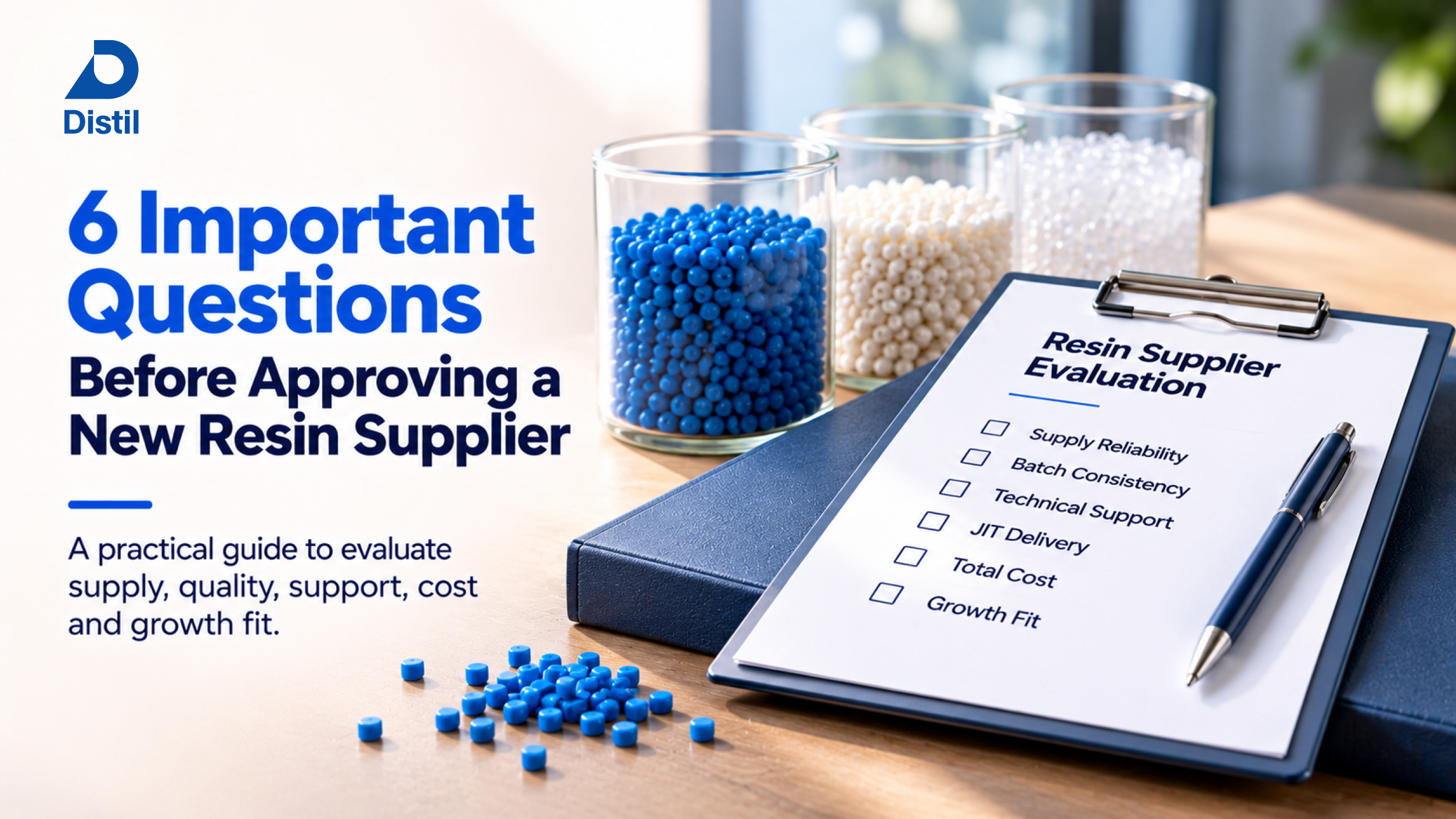
A lower resin price can look attractive on a procurement spreadsheet. But ₹/kg is only the starting point. An alternative grade may appear cheaper yet create higher costs through longer cycle times, increased rejection, additional material preparation, inconsistent batches or supply disruptions. Approving a new resin therefore requires procurement teams to look beyond the initial trial and evaluate whether the material can deliver reliable production performance, consistent quality and dependable supply.
Approving an alternative resin is more than confirming that it can produce an acceptable part. A stronger qualification process evaluates process fit, part quality, material efficiency, lot consistency, supply reliability and total cost. The supplier should also be assessed for lead time, inventory availability, technical support, change notification and its ability to support future production requirements. Looking at these factors together helps procurement teams distinguish between a resin that is simply cheaper to buy and one that can become a reliable, commercially viable alternative for regular production.
The first question is simple:
Can the alternative resin run reliably on your existing machine and mould?
A successful first shot only shows that the material can produce a part under those conditions. It does not prove that the process will remain stable throughout production.
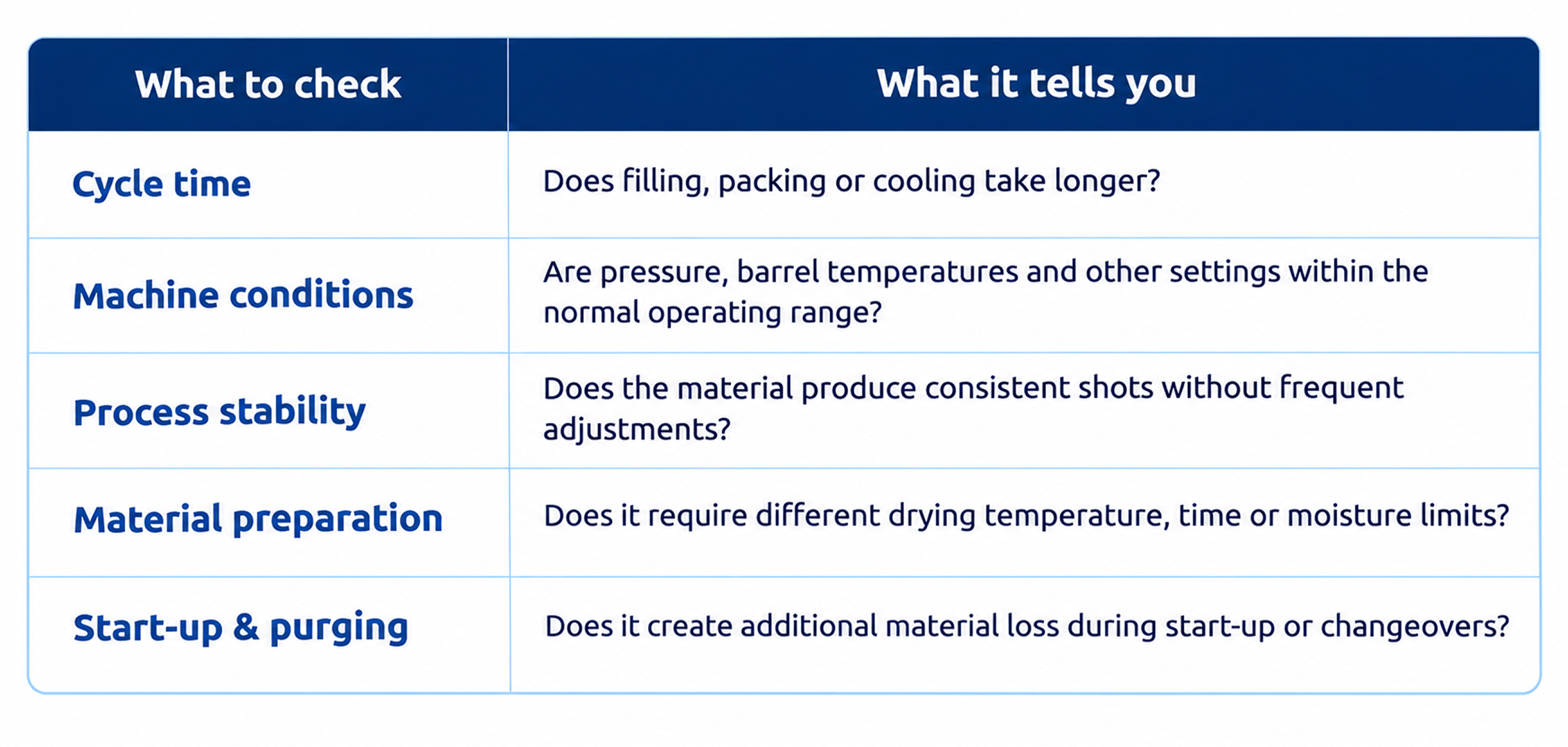
The key question is not whether the resin can produce one acceptable part.
It is whether it can maintain a stable operating window throughout production.
A datasheet can help you shortlist a grade.
It cannot tell you exactly how that grade will behave in your mould.
Always evaluate the actual moulded parts against the requirements of the application.
Surface quality
Are there changes in gloss, flow marks, sink marks, splay or other cosmetic defects?
Part weight
Is shot-to-shot weight stable?
Mechanical performance
Does the part meet the required impact, stiffness, strength or heat-resistance requirements?
Application requirements
Does the material meet the specifications required by your customer or end application?
Compliance & documentation
Does the grade have the required regulatory, certification and customer documentation?
For moisture-sensitive or semi-crystalline materials, dimensional and property comparisons should be performed after the appropriate conditioning period for the material and application.
The performance of the moulded part — not simply how closely the alternative matches the datasheet.
Two resins can have different purchase prices but very different economics at the part level.
Instead of asking:
“Which resin costs less per kilogram?”
ask:
“How much material does it take to produce one accepted part?”
Part weight is particularly useful because differences in density or processing behaviour can change how much material is consumed for the same component.
If regrind is permitted for the application, define the acceptable regrind percentage and evaluate whether repeated thermal history affects processing or critical part properties.
One good sample proves that the material can work. It does not prove that every future lot will behave the same way.
For higher-confidence qualification, manufacturers may choose to evaluate multiple production lots — often three — depending on application risk, customer requirements and their internal approval process.
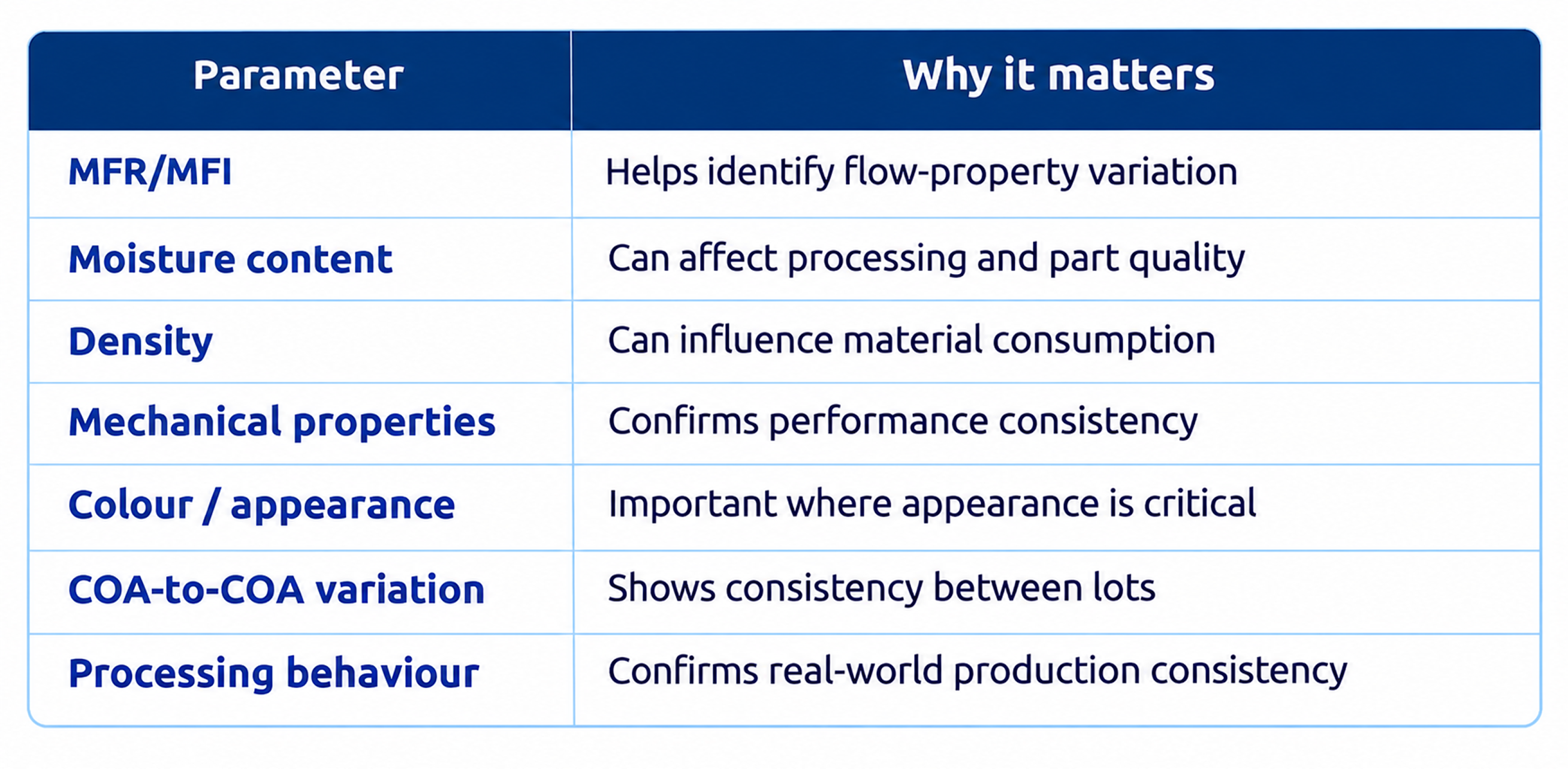
Also confirm that the supplier is testing the material using the same test method and conditions used for your comparison.
The objective is not just to qualify a resin sample.
It is to understand whether the supplier can deliver consistent material over time.
A technically suitable resin can still become a production problem if you cannot reliably source it.
Before approval, evaluate the supplier as well as the polymer.
Lead time
How quickly can regular orders be supplied?
Local inventory
Is material stocked locally or supplied only against imports or production orders?
MOQ
Does the minimum order quantity fit your actual consumption?
Price validity
How long will the quoted price remain valid?
Packaging
Are bags, liners and seals suitable for protecting the material during storage and handling?
Supply continuity
Can the supplier support increased demand?
Change notification
Will the supplier notify you before changes to formulation, manufacturing location or other factors that could affect approved performance?
Alternative supply
Is there another qualified grade or source if the primary grade becomes unavailable?
Change-notification requirements should be clearly defined in the supplier agreement or quality documentation rather than assumed.
This is where the procurement decision should ultimately land.
The cheapest invoice price does not always produce the lowest manufacturing cost.
A practical comparison is:
Material Cost + Machine Cost + Energy/Processing Cost + Scrap Loss + Logistics
An alternative resin is ₹5/kg cheaper.
For a 50 g part:
₹5 × 0.05 kg = ₹0.25 material saving per part
But suppose the current grade runs at a 20-second cycle and the alternative increases the cycle to 22 seconds.
That is a 10% increase in cycle time, reducing theoretical cycles per hour by roughly 9%.
Whether the ₹0.25 material saving offsets that increase depends on the machine-hour cost, energy consumption, rejection rate and other production factors.
That is why the comparison should not stop at ₹/kg.
What does it cost to produce one accepted part?
Use this as a quick procurement review before approving an alternative grade
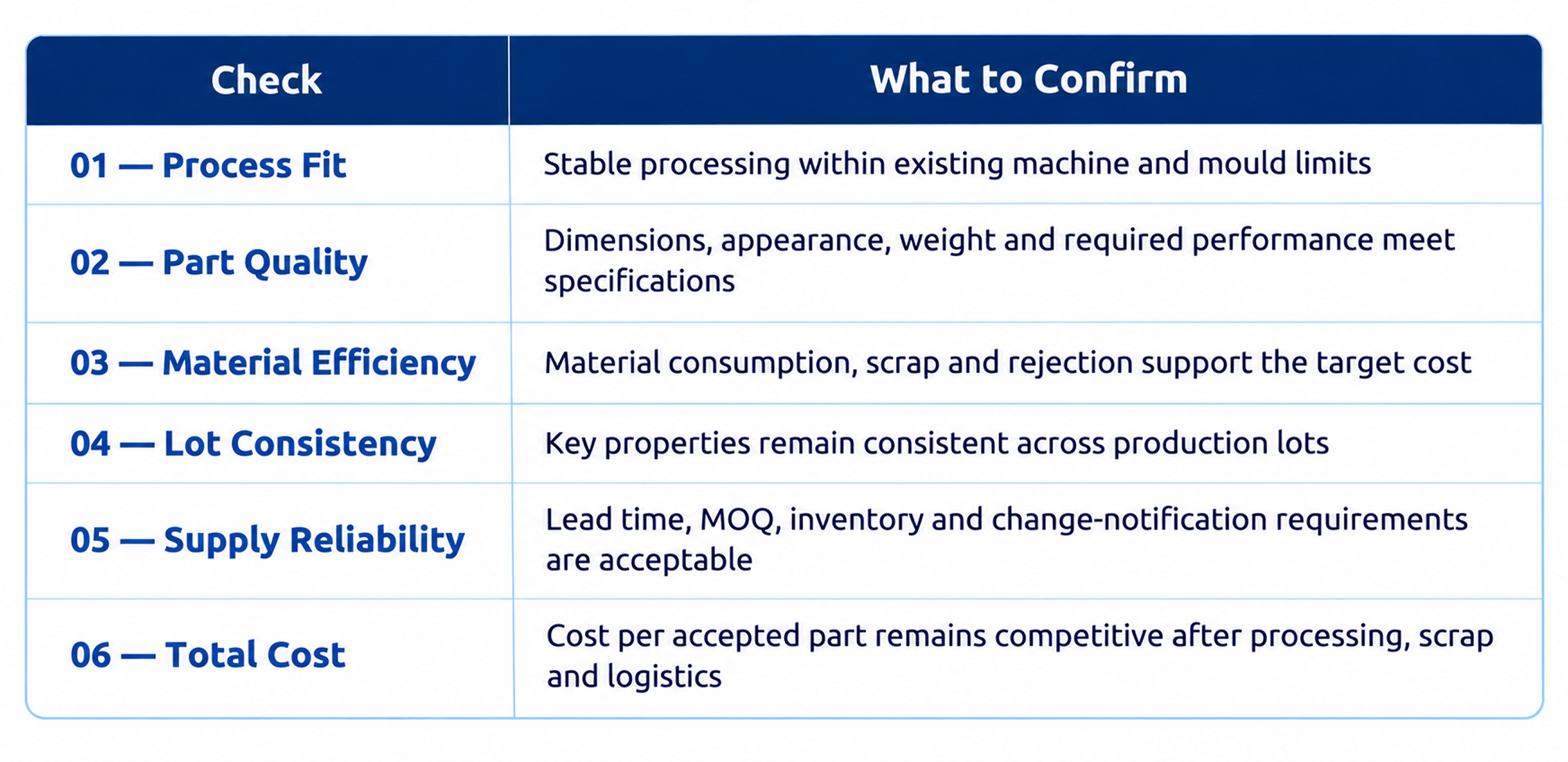
One of the easiest mistakes in material qualification is running the trial first and deciding the acceptance criteria afterward.
Instead, define the pass/fail criteria before the trial begins.
This gives procurement, production, quality and engineering teams the same definition of “approved.”
It also makes the trial easier to evaluate because the decision criteria are established before production results are available.
MFR/MFI is useful when screening alternative grades, but it should not be the only matching criterion.
Two materials with similar MFR values can still behave differently because of differences in:
Use MFR as one part of the qualification process, then verify the properties and processing behaviour that actually matter for your application.
Usually, no.
A successful trial demonstrates that the material can produce an acceptable part under the tested conditions. It does not automatically establish long-term lot consistency, supply reliability or production economics.
The depth of qualification should depend on application risk, customer requirements and your internal approval process.
Not necessarily.
Similar MFR can be useful when screening candidates, but it does not guarantee equivalent processing or part performance.
The alternative should also be evaluated against the properties and processing requirements that are critical to the application.
There is no universal number that applies to every resin and application.
For higher-confidence qualification, many manufacturers choose to evaluate multiple production lots, often three. The appropriate number should be determined by application risk, customer requirements and your internal quality process.
Part weight provides a practical measure of material consumption and process stability.
Even small differences can affect material cost per accepted part when production volumes are high.
Procurement should consider:
Material consumption + cycle time + rejection + energy and drying requirements + logistics + lead time + supply reliability + cost per accepted part.
The purchase price is only one part of the decision.
Before full production qualification.
If the application requires specific food-contact requirements, RoHS/REACH compliance, UL94 classification, OEM specifications or other certifications, confirm the alternative grade's documentation before investing significant trial time.
At Distil, we help manufacturers identify and evaluate alternative polymer grades based on technical requirements, application fit, supplier documentation and supply considerations.
Whether you are looking for a second source, benchmarking your current grade or evaluating a new material for production, the right comparison starts with understanding what your existing grade needs to deliver — and what the alternative needs to match.
Talk to the Distil team about your material requirements and trial objectives.
Email: polymers@distil.market

READ MORE


READ MORE
READ MORE

READ MORE
READ MORE
READ MORE
READ MORE

READ MORE

READ MORE

READ MORE
READ MORE
READ MORE

READ MORE
READ MORE
READ MORE
READ MORE
READ MORE
READ MORE
READ MORE
READ MORE

READ MORE
READ MORE

READ MORE

READ MORE
READ MORE

READ MORE

We enable global brands to diversify production and accelerate sustainable sourcing while protecting IP.
Corporate Presentation
Follow us


© 2026 Distil. All rights reserved.


