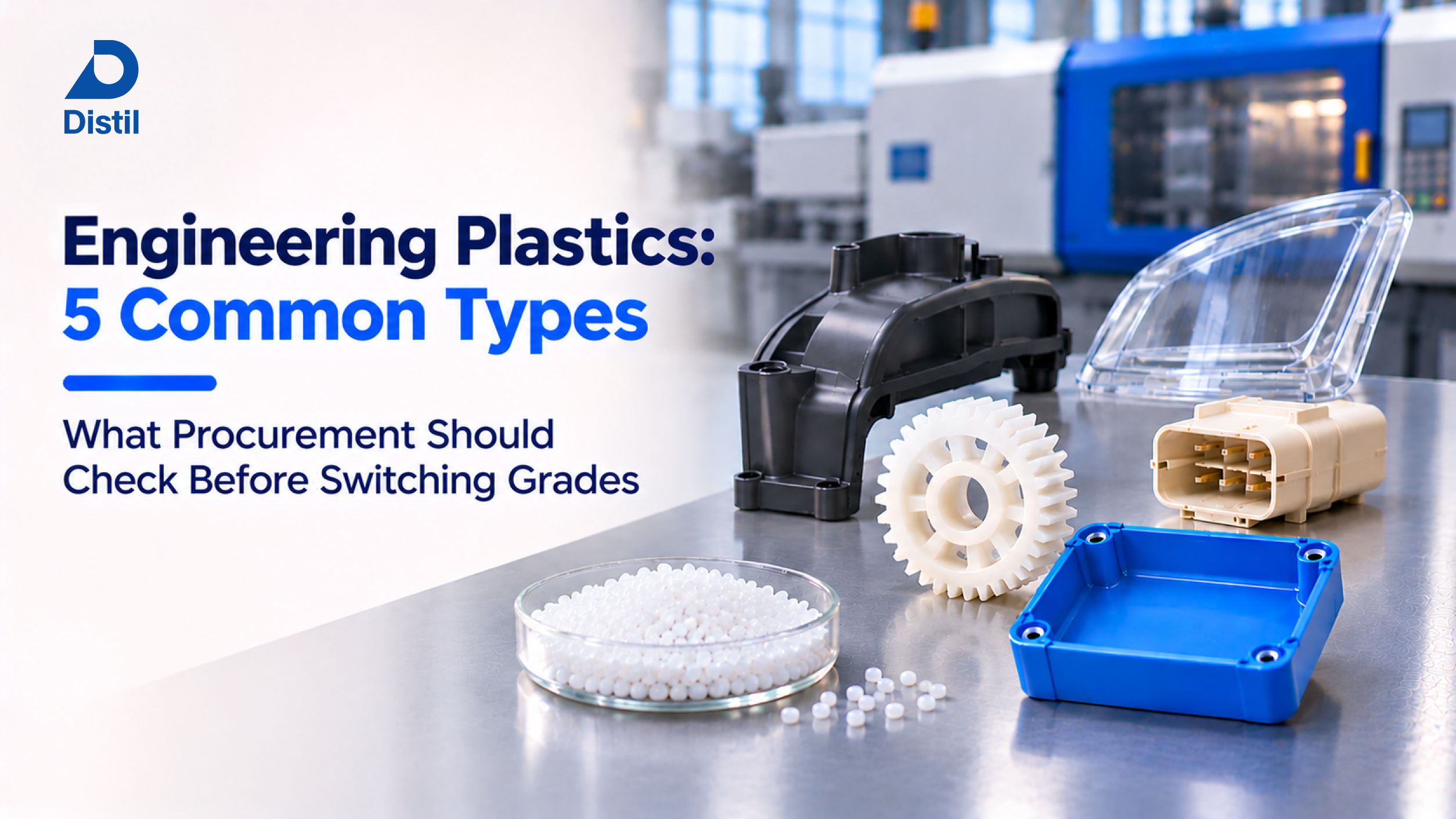
Engineering Plastics: 5 Common Types and What Procurement Should Check Before Switching Grades

Page Content

27th November, 2026

‍

Introduction

‍

Sourcing an alternative engineering plastic involves far more than comparing price per kilogram. A competing resin may appear cheaper on a quote sheet, but differences in melt flow, shrinkage, reinforcement, additives, or processing requirements can affect cycle time, scrap rates, dimensional performance, and overall production cost.

Different grades within the same polymer family can behave differently on the molding floor and in the finished application. Procurement teams therefore should not treat polymer families as interchangeable. A viable alternative should be evaluated at the grade level, considering application requirements, processing behavior, compliance documentation, supply consistency, and total landed cost.

‍

Executive Summary

‍

Engineering plastics are used across automotive, electrical, industrial, appliance, and consumer applications. Common engineering plastics include PA/Nylon, Polycarbonate (PC), POM/Acetal, PBT, and ABS/PC-ABS.

‍

For procurement teams, the polymer family alone does not establish grade equivalence. A structured evaluation should consider four key areas:

  • Grade-Level Performance: Mechanical strength, impact performance, heat and chemical resistance, and dimensional behavior under actual operating conditions.
  • Processing Requirements: Melt flow or rheological behavior, moisture sensitivity, drying requirements, thermal stability, and compatibility with existing molding conditions.
  • Compliance & Consistency: Required certifications and declarations, such as UL recognition, RoHS/REACH requirements, alongside lot-to-lot consistency and supply reliability.
  • Total Landed Cost: Whether the quoted material saving remains meaningful after considering qualification, scrap, cycle time, tooling changes, freight, duties, and inventory requirements.

‍

Why Polymer Family Does Not Mean Grade Equivalence

‍

Two resins sharing the same polymer family can have different molecular characteristics, reinforcement levels, additive packages, and processing behavior.

‍

Before approving a lower-cost alternative, compare the specific grades across four core areas:

  • Mechanical Strength and Impact: Stiffness, tensile strength, toughness, and performance under the temperatures and loads expected in the application.
  • Thermal and Chemical Resistance: Resistance to heat, hydrolysis, fuels, cleaners, lubricants, or other chemicals relevant to the application.
  • Dimensional Stability: Mold shrinkage, warpage, and dimensional change during and after molding.
  • Processability: Melt flow or rheological behavior, drying requirements, processing window, and thermal stability during injection molding.

A datasheet can identify whether a grade is worth evaluating. Production trials and application-level validation determine whether it is a suitable replacement.

‍

‍

1. PA / Nylon: Check Conditioning State and Reinforcement

‍

Polyamides (PA) are widely used in applications such as under-the-hood components, clips, industrial gears, wear components, and electrical parts.

Because nylon is hygroscopic, moisture absorption can change its dimensions and mechanical properties after molding. Conditioning generally increases toughness and ductility while reducing stiffness, with the magnitude depending on the PA grade, reinforcement, and moisture exposure.

‍

What procurement should check:

‍

  • PA6 vs. PA66: PA66 generally offers a higher melting temperature and strong high-temperature performance, while PA6 can offer processing and toughness advantages depending on the grade and application. Compare the actual grades rather than assuming one family is universally better.
  • Dry-As-Molded (DAM) vs. Conditioned Data: Ensure properties are being compared under the same conditioning state. A DAM value should not be directly compared with a conditioned value.
  • Glass-Fiber Content: Match the reinforcement type and loading, such as 30% glass fiber, because differences can affect strength, stiffness, shrinkage, warpage, and tool wear.
  • Heat-Aging Performance: For high-temperature applications, review long-term property retention and confirm that the grade's stabilization system is suitable for the required service conditions.

‍

‍

2. Polycarbonate (PC): Verify Impact, Clarity, and Compliance

‍

Polycarbonate is widely used in automotive lighting components, electrical housings, meter covers, safety shields, and other applications where toughness and, in some grades, transparency are required.

PC can be sensitive to chemical attack and UV exposure, depending on the grade and stabilization system.

‍

What procurement should check:

‍

  • Notched Izod Impact: Compare impact strength at the temperatures relevant to the application, including low-temperature conditions where required.
  • HDT / Vicat Performance: Confirm that the grade provides adequate thermal performance under the expected load and operating temperature.
  • Optical Performance and UV Stabilization: For transparent applications, compare light transmission, haze, color stability, and UV-stabilization requirements.
  • Chemical Compatibility: PC can be susceptible to environmental stress cracking when exposed to certain chemicals while under stress. Test against the actual cleaners, solvents, lubricants, or other chemicals expected in service.
  • UL 94 and UL Recognition: For electrical applications, verify the required flame-retardant classification at the specified wall thickness and confirm that the specific grade has the required UL recognition.

‍

‍

3. POM / Acetal: Account for Shrinkage and Thermal Stability

‍

Polyoxymethylene (POM) is widely used for precision gears, valves, seatbelt mechanisms, bearings, and other components requiring stiffness, dimensional accuracy, and low friction.

‍

What procurement should check:

‍

  • Homopolymer (POM-H) vs. Copolymer (POM-C): POM-H generally provides higher short-term strength and stiffness, while POM-C offers a wider processing window and strong resistance to thermal degradation and hot-water exposure. Actual fatigue and wear performance should be compared at the grade level.
  • Mold Shrinkage: Switching between POM-H and POM-C—or even between different flow grades—can change shrinkage behavior. In tight-tolerance components, these differences can affect dimensional performance and may require process or tooling adjustments.
  • Wear and Friction: For moving components, check the grade's coefficient of friction, wear performance, and whether internal lubricants or other modifications are required for the application.
  • Thermal Stability: POM requires careful processing control. Overheating can cause thermal degradation and release formaldehyde-containing decomposition products. Follow the supplier's recommended processing window and safety guidance.

‍

‍

4. PBT: Match Electrical and Hydrolysis Resistance

‍

Polybutylene terephthalate (PBT) is a semi-crystalline polyester used in electrical connectors, sensor housings, automotive components, appliance parts, and other applications requiring dimensional stability and electrical performance.

Some standard PBT grades can experience hydrolytic degradation during prolonged exposure to heat and moisture. For demanding environments, hydrolysis-resistant grades may be required.

‍

What procurement should check:

‍

  • Comparative Tracking Index (CTI): For electrical applications where surface tracking is a design consideration, verify the required CTI rating against the applicable electrical standard and end-use conditions.
  • Hydrolysis Resistance: For applications exposed to prolonged heat and moisture, specify a suitable hydrolysis-resistant grade and review long-term property-retention data.
  • Drying and Processing Sensitivity: PBT requires controlled drying before molding. Excess moisture during processing can promote hydrolysis, reducing molecular weight and potentially affecting part performance.
  • Glass Reinforcement and UL 94: Verify the required flame-retardant classification at the part's minimum wall thickness and compare reinforcement levels because additive packages and reinforcement can affect mechanical properties.

‍

‍

5. ABS and PC/ABS: Look Beyond the Material Label

‍

Standard ABS offers a balance of toughness, processability, appearance, and cost for applications such as appliance housings and consumer products.

PC/ABS blends combine polycarbonate and ABS to achieve different balances of impact strength, heat resistance, processability, appearance, and cost. However, PC/ABS is not one fixed formulation.

‍

What procurement should check:

‍

  • Grade Formulation: PC/ABS grades can use different PC-to-ABS ratios and additive packages, which can significantly affect heat resistance, impact performance, flow, appearance, and cost. Compare the actual grade rather than relying on the PC/ABS label alone.
  • Vicat Softening Temperature / HDT: Check thermal performance against the temperatures expected in the application.
  • Notched Izod Impact: Confirm impact resistance at the lowest temperature the finished part is expected to experience.
  • Surface Appearance and Colorability: For visible components, evaluate gloss, surface finish, color consistency, and paintability where applicable.

‍

‍

A 6-Point Procurement Checklist for Qualifying Alternatives

‍

Use this checklist to evaluate alternative resin quotes before moving to molding trials:

‍

1. Application Fit

Does the grade meet the required thermal, mechanical, chemical, dimensional, and environmental requirements of the actual end-use application?

‍

2. Datasheet Equivalence

Are you comparing properties using the same test method, specimen condition, temperature, humidity, and conditioning state?

‍

3. Regulatory and OEM Compliance

Does the grade have the required certifications, declarations, UL recognition, or OEM material approvals for the application?

‍

4. Processing Window

Can the molder process the resin using the existing equipment and tooling without creating drying bottlenecks, cycle-time penalties, dimensional issues, or excessive scrap?

‍

5. Lot-to-Lot Consistency and Supply Security

Does the supplier provide appropriate quality documentation, such as Certificates of Analysis (CoAs), for critical properties? What are the supplier's typical lead times, regional inventory position, and contingency plans for supply disruptions?

‍

6. Total Landed Cost

Do the per-kilogram savings remain meaningful after factoring in qualification testing, tooling adjustments, scrap, cycle time, freight, duties, inventory, and working capital?

‍

‍

Frequently Asked Questions

‍

When can an alternative plastic be considered a potential drop-in replacement?

‍

An alternative grade can be considered a potential drop-in replacement when it meets the application's required performance, processing, dimensional, and compliance requirements on the existing equipment and tooling.

Similarity in polymer family or datasheet values alone is not sufficient. Production trials and application-level validation are still required before the material is approved for regular production.

‍

How long does it typically take to qualify an alternative engineering plastic?

‍

Qualification time varies significantly by application and approval requirements.

A relatively simple commercial application may be evaluated within a few weeks, while automotive, medical, electrical, or other highly regulated applications can require several months because of additional testing, validation, customer approval, and documentation requirements.

‍

What is the biggest hidden cost when switching to a cheaper resin?

‍

The hidden cost is often the impact on total cost per accepted part.

A resin that costs less per kilogram can still increase overall production cost if it requires longer cooling times, tighter process control, additional drying, higher scrap rates, tooling adjustments, or more extensive qualification.

‍

‍

Sourcing an Engineering Plastic Alternative?

Distil helps procurement and engineering teams identify, compare and qualify application-matched polymer alternatives without compromising production requirements.

Email: polymers@distil.market
Frequently Asked Questions

No items found.

Related articles

Engineering Plastics: 5 Common Types and What Procurement Should Check Before Switching Grades

READ MORE

Before You Approve an ABS Grade, Check This

READ MORE

Don’t Wait for a Resin Shortage to Qualify a Backup

READ MORE

Why Does ABS Turn Yellow? 4 Causes to Check Before Changing Your Resin Supplier

READ MORE

ABS Drying Conditions: What Procurement Teams Should Check

READ MORE

Sink marks in injection-moulded toys: Material, mould, or processing?

READ MORE

ABS vs PP vs HIPS: Which Plastic Fits Your Toy Component?

READ MORE

Metal-plating ABS: Material selection & process control

READ MORE

Heat-Resistant ABS: Properties, Thermal Performance & Grade Selection

READ MORE

Flame-Retardant ABS: UL 94 Ratings, Properties & How to Choose the Right Grade

READ MORE

Before You Approve an Alternative Resin: 6 Checks Procurement Should Make

READ MORE

6 Important Questions Before Approving a New Resin Supplier

READ MORE

Thinking of Switching Your ABS Supplier? 5 Critical Checks Before Making the Change

READ MORE

Toy Design Trends 2026: Choosing the Right Polymers for Modern Toy Manufacturing

READ MORE

Common Injection Moulding Defects: Causes, Troubleshooting and Engineering Solutions

READ MORE

Procuring ABS? Are You Really Getting the Best Price?

READ MORE

SAN Grades: How to Evaluate Performance, Processing and Total Cost

READ MORE

Selecting the Right ASA Grade: A Guide to Performance, Processing and Cost

READ MORE

ABS Grade Selection for Toy Manufacturing: Balancing Impact Resistance, Processing, Regulatory Compliance and Cost

READ MORE

Styrenics: Understanding the Performance Differences Across GPPS, HIPS, ABS, SAN, ASA and SBC

READ MORE

Zinc Oxide in SPF Formulation: Balancing UV Protection, Whitening & Sensory Experience

READ MORE

Antistatic Masterbatches: Controlling Static for Cleaner, Smoother Polymer Processing

READ MORE

Why Modern Mineral Sunscreens Leave Less White Cast

READ MORE

Phenoxyethanol: Supporting Quality, Stability & Safety

READ MORE

Polysorbate 20, 60 and 80: Understanding Their Formulation Profiles

READ MORE

Zinc Oxide: The Evolution of Modern UV Protection

READ MORE

←→

We enable global brands to diversify production and accelerate sustainable sourcing while protecting IP.

Corporate Presentation

© 2026 Distil. All rights reserved.