
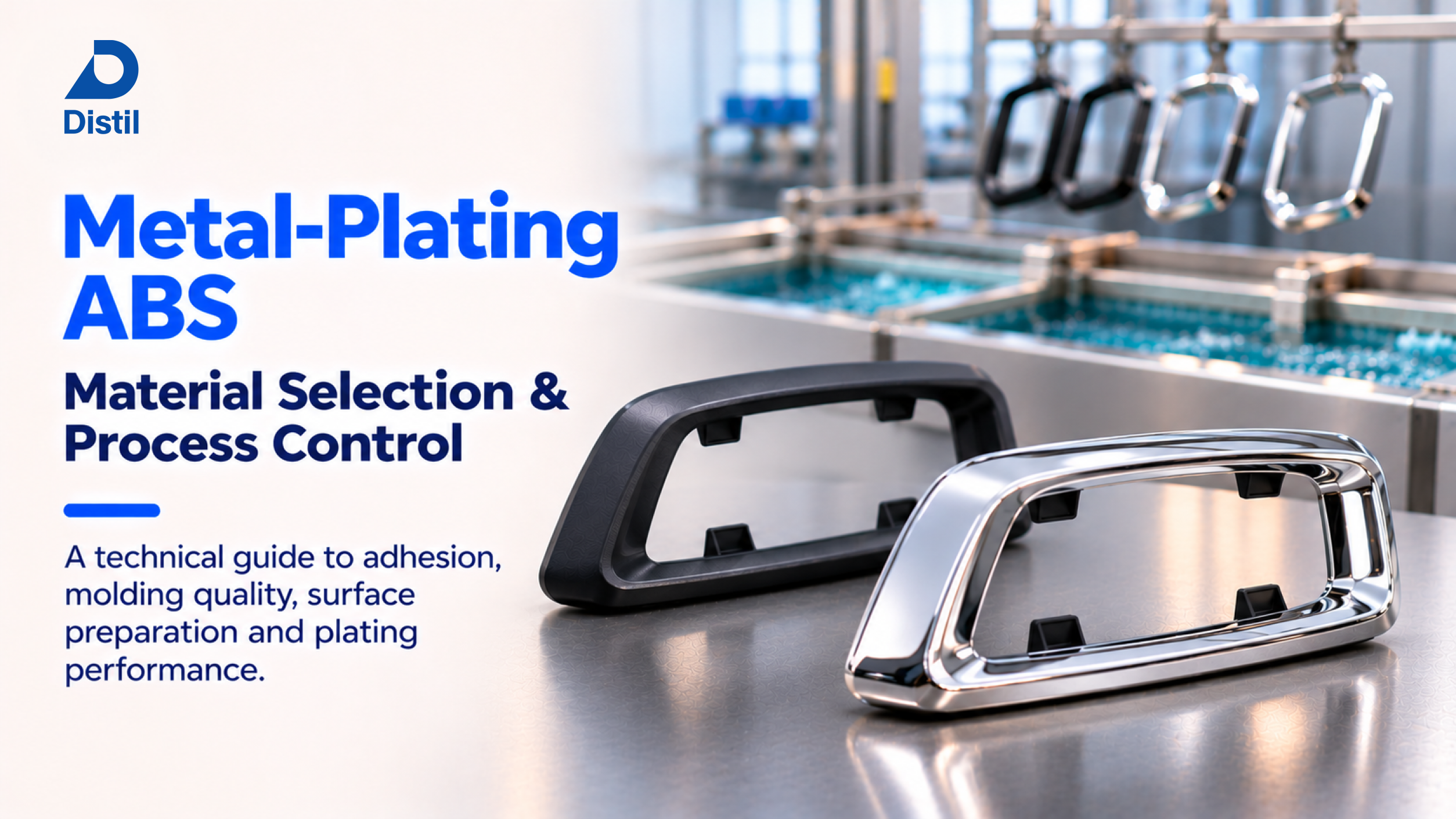
Metal-plated ABS combines the lightweight, design flexibility, and processing advantages of injection-molded thermoplastics with the appearance and functional performance of a metallic surface. It is used across automotive trim, sanitary fittings, appliances, electronics, and other applications where a premium metallic finish is required without using a fully metallic component. However, successful plating starts well before the plating line. Resin selection, part design, molding conditions, surface preparation, and plating chemistry all influence adhesion, appearance, and durability.
Plating-grade ABS is engineered with a controlled rubber phase that can be selectively etched to create microscopic surface features for metal adhesion. Consistent results depend on maintaining the right surface morphology while minimizing molded-in stress, orientation, moisture, and contamination during injection molding. The plating process then builds adhesion through etching, activation, electroless deposition, and electroplating. When selecting a grade, evaluate not only melt flow and mechanical properties but also plating adhesion, thermal-cycle resistance, surface quality, process stability, and compatibility with the intended pretreatment system.
ABS contains a continuous styrene-acrylonitrile (SAN) matrix with a dispersed polybutadiene rubber phase. Plating-grade ABS is formulated with controlled rubber content and morphology so that the surface can be etched consistently.
The exact formulation and rubber morphology vary between grades. For plating applications, consistency of the rubber phase is more important than simply targeting a particular butadiene percentage.
The quality of the molded substrate directly affects the final plated surface. The objective is to produce a part with consistent surface morphology, low residual stress, and minimal defects.
Melt temperature and injection speed
Excessive injection speed can increase surface orientation and stress, while insufficient melt temperature can increase viscosity and shear during filling. Processing should therefore be optimized within the resin supplier's recommended window.
Mold temperature
An appropriate mold temperature can improve surface replication and reduce frozen-in orientation and residual stress. The optimum setting depends on the grade and part geometry.
Moisture control
ABS should be properly dried before molding. Inadequate drying can cause splay and other moisture-related defects that may compromise plating performance. Drying conditions should follow the resin supplier's datasheet.
Contamination control
Silicone-based and other external mold-release agents can interfere with wetting, activation, and metal adhesion. For critical plated parts, release agents should generally be avoided unless their compatibility with the plating process has been verified.
Plating can make existing molding defects more visible rather than hiding them.
Common defects that can affect the final appearance include:
For cosmetic applications, mold design, gate location, filling behavior, cooling, packing, and surface finish should therefore be considered part of the plating qualification process.
A typical plating process involves several stages:
Molding → Etching → Activation → Electroless Deposition → Electroplating → Final Finish
During chemical etching, the polybutadiene-rich phase is preferentially attacked, creating microscopic surface features. The surface is then activated to enable deposition of a conductive metal layer, after which additional metal layers can be electroplated.
Plating adhesion therefore depends on the combined performance of:
A resin should therefore be qualified with the actual plating system rather than evaluated independently.
ABS expands and contracts more than most of the metallic layers used in decorative plating. During temperature changes, this difference in expansion can create stress within the coating and at the polymer-metal interface.
A decorative plating system may include electroless copper or nickel, ductile copper, nickel layers, and a chromium topcoat. The exact stack depends on the application and plating specification.
A ductile copper layer, where used, can help distribute and accommodate stresses within the coating during thermal cycling.
Reliable performance depends on:
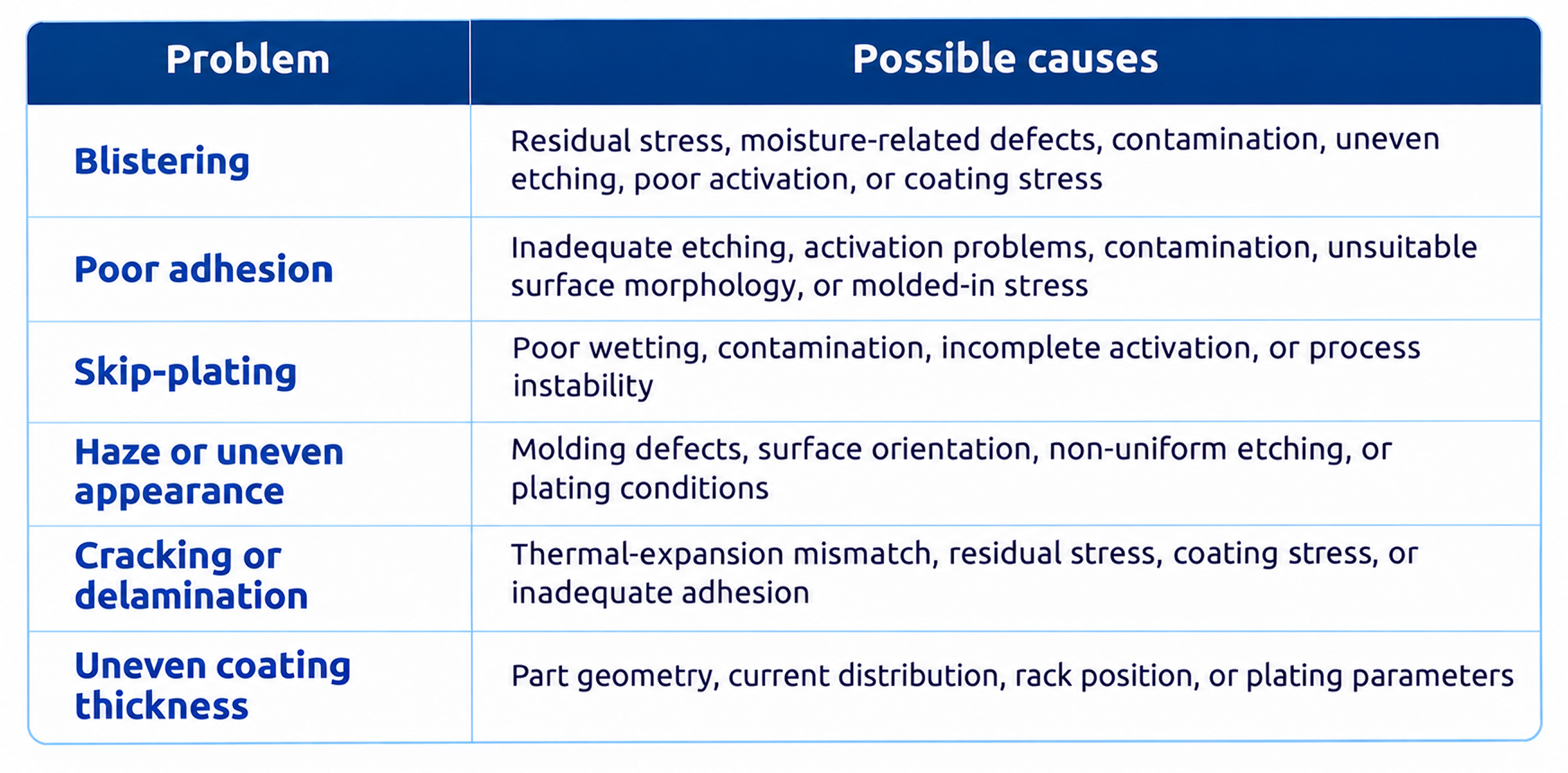
The same visible defect can have different root causes, so troubleshooting should cover the complete molding and plating process.
Plating-grade ABS is used for interior bezels, air vents, switchgear, door-handle components, and decorative trim. It provides a metallic appearance while retaining the lightweight and design flexibility of molded plastic.
Where higher heat resistance, impact performance, or dimensional stability is required, plating-grade PC/ABS may be considered.
Plated polymer components can be used for faucet handles, trim rings, escutcheons, showerhead components, and other decorative fittings. Performance depends on the substrate, plating stack, corrosion resistance, thermal cycling, and chemical exposure.
Plated ABS is used for knobs, control panels, decorative housings, and trim components. Electroless copper or nickel coatings can also provide conductive surfaces for EMI/RFI shielding when coating continuity, thickness, grounding, and shielding design are properly controlled.
Use ASTM B533 as a standardized method for comparative peel-strength testing on molded plaques. Establish application-specific acceptance criteria rather than treating the test method as a universal pass/fail specification.
Production parts should also undergo application-specific adhesion and durability testing.
Test plated parts according to the applicable customer or industry specification. Check for blistering, cracking, delamination, loss of adhesion, and cosmetic changes.
Match melt flow and processing characteristics to the part's wall thickness, flow length, gate design, and molding equipment.
Confirm that the resin performs consistently with the actual etching, activation, and plating chemistry used by the plating supplier.
Evaluate both the molded substrate and the final plated part. A resin that meets mechanical requirements may still be unsuitable for a highly cosmetic application if it produces inconsistent surface quality.
6. Production Consistency
Where possible, evaluate multiple resin lots and production conditions to confirm stable plating adhesion, appearance, and processing performance.
Regrind is generally avoided for critical plated parts because additional thermal history and potential contamination can affect material consistency and plating performance. If permitted, its percentage and handling should be controlled and validated for the specific application.
ABS generally offers good flow, easier etching, and cost advantages. PC/ABS can provide higher heat resistance, impact performance, and dimensional stability when the application requires them.
Possible causes include molded-in stress, moisture-related molding defects, contamination, non-uniform etching, inadequate activation, and coating stress during thermal cycling. Root-cause analysis should consider both molding and plating.
Where included in the coating stack, ductile copper can help distribute and accommodate stresses between the polymer substrate and harder metallic layers during thermal cycling.
Yes. Some plating-grade ABS systems can be qualified for newer pretreatment technologies. Performance depends on the specific resin, chemistry, activation system, and operating conditions, so compatibility should be validated with the plating supplier.
For formulation details, reach out to polymers@distil.market.
READ MORE


READ MORE
READ MORE
READ MORE
READ MORE
READ MORE
READ MORE
READ MORE
READ MORE
READ MORE
READ MORE
READ MORE

READ MORE
READ MORE
READ MORE
READ MORE
READ MORE
READ MORE
READ MORE
READ MORE
READ MORE
READ MORE
READ MORE
READ MORE
READ MORE

READ MORE

We enable global brands to diversify production and accelerate sustainable sourcing while protecting IP.
Corporate Presentation
Follow us


© 2026 Distil. All rights reserved.


