
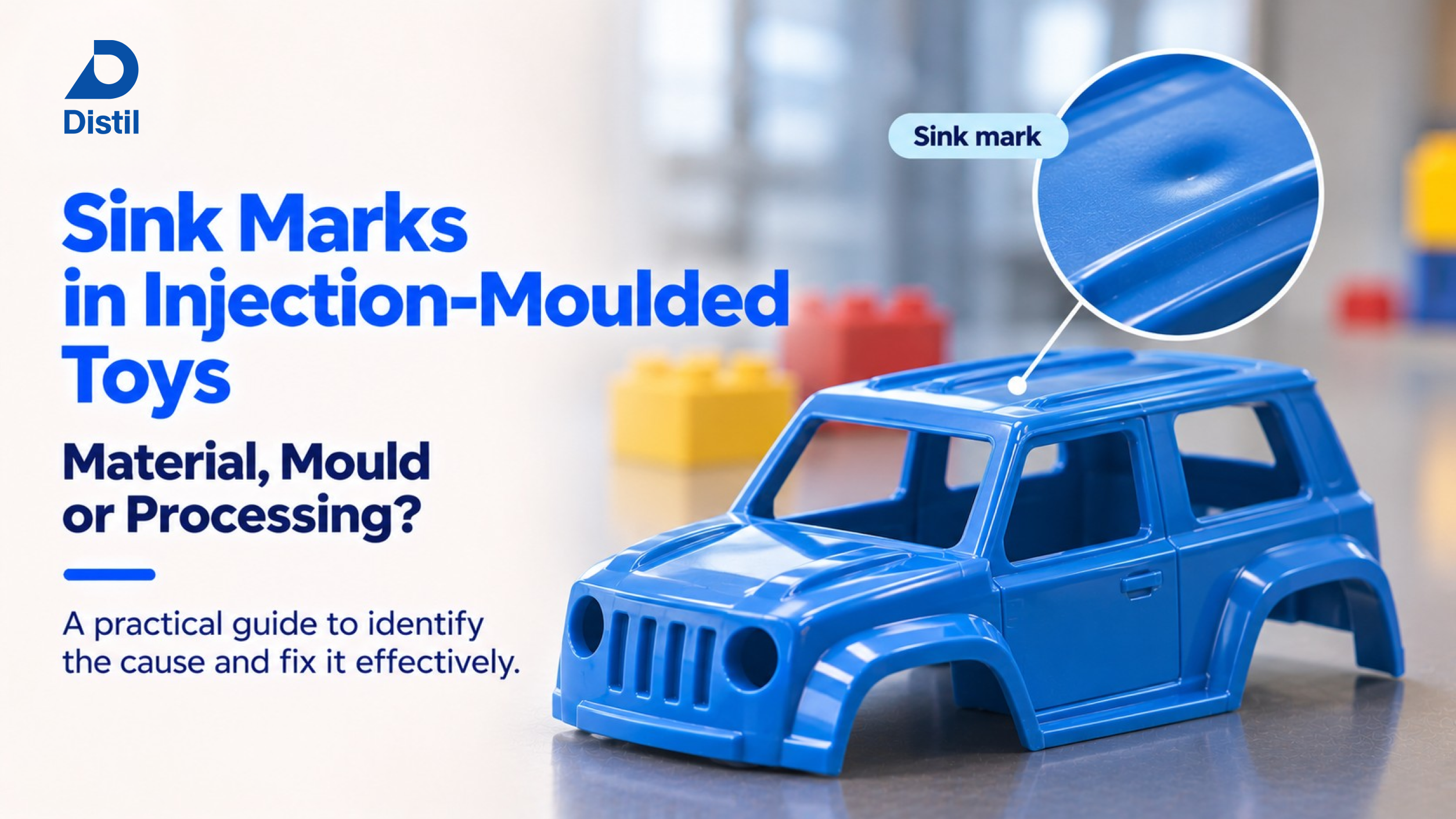
Sink marks are visible surface depressions that typically develop above or near thicker sections of an injection-moulded part, such as screw bosses, ribs, gussets, and abrupt wall transitions. In toys, even shallow sinks on glossy shells, character faces, or visible housings can affect perceived quality. Around bosses and clips, they may also indicate local shrinkage that affects assembly or dimensional performance.
A sink mark is a symptom, not automatically a material problem. The cause can lie in part geometry, mould design, packing, cooling, processing conditions, or resin selection. Changing the resin or modifying the mould before identifying the actual driver can add unnecessary trial time and cost.
Sink marks occur when a thicker section continues to cool and shrink after the surrounding surface has solidified. If sufficient polymer cannot be packed into the shrinking region before the gate freezes, the surface can be pulled inward.
Material influences shrinkage behaviour. Semi-crystalline PP generally has higher mould shrinkage than amorphous ABS and HIPS, but actual performance depends on the specific grade, geometry, processing conditions, and formulation.
A practical troubleshooting sequence is:
Geometry → packing → gate freeze-off → cooling → mould design → material selection
The goal is to identify why the section is shrinking and whether the moulding process is adequately compensating for it.
During moulding, polymer near the cavity wall cools and solidifies first, forming an outer skin. Thicker sections remain hot longer and continue to contract as they cool.
If the shrinking region can still be fed through the gate, packing pressure can compensate for some of this volume loss. Once the gate freezes—or if packing is insufficient—the remaining shrinkage can pull the surface inward.
Common locations include:
Both can result from volumetric shrinkage, but they are different defects.
A sink mark is a visible surface depression. A void is an internal cavity formed when the shrinking interior cannot be adequately fed. A thick section can therefore produce a sink, a void, or both.
PP
PP (Polypropylene) is semi-crystalline and generally exhibits higher mould shrinkage than amorphous ABS and HIPS. It is widely used in toys because of its cost, toughness, chemical resistance, and processability, but thick sections and inadequate packing can increase sink risk.
ABS and HIPS
ABS and HIPS are amorphous thermoplastics and generally exhibit lower mould shrinkage than unfilled PP. They can be attractive where surface appearance, stiffness, impact performance, and dimensional control are important.
However, neither material is inherently sink-proof. A poorly packed or poorly designed part can still develop sink marks.
Additives and regrind
Fillers, impact modifiers, and other additives can change flow and shrinkage behaviour. Significant changes in regrind level or material composition can also affect consistency.
If sink depth changes between production lots despite stable tooling and processing, material consistency should be investigated.
Maintain uniform wall thickness
Large changes in wall thickness create different cooling rates and shrinkage levels. Where possible, use relatively uniform walls and gradual transitions.
Control rib thickness
Ribs that are too thick can create excessive polymer mass and cause sink on the opposite cosmetic surface.
A commonly used DFM guideline is to keep rib thickness around 50–60% of the nominal wall thickness, while validating the ratio against the resin, rib height, structural requirements, and cosmetic expectations.
Design bosses carefully
Avoid unnecessary solid mass around bosses. Appropriate boss-wall thickness, coring, and gussets can provide the required strength without creating excessive local thickness.
Gate and cooling design
Gate size and location determine how effectively the affected region can be packed before gate freeze-off.
Cooling should also be reasonably uniform, particularly around thicker sections that retain heat longer.
Packing pressure compensates for material shrinkage while the gate remains open.
Hold time should be long enough to take advantage of this packing window. A practical diagnostic is to increase hold time incrementally and weigh the parts. When part weight reaches a plateau, additional hold time is no longer adding significant material to the cavity, indicating that the gate has effectively frozen.
Keep temperatures within the resin supplier's recommended processing range. Temperature affects viscosity, filling, cooling, surface replication, and shrinkage, so it should be evaluated together with packing and gate-freeze behaviour.
Cooling time helps the part reach sufficient rigidity for ejection and can affect dimensional stability. However, once the gate has frozen, additional cooling cannot compensate for insufficient packing.
1. Map the defect
Identify exactly where the sink appears and what is located behind it—rib, boss, gusset, wall transition, or gate.
2. Check geometry
Measure the affected section and look for excessive local thickness or abrupt transitions.
3. Audit packing
Review packing pressure, hold time, cushion, gate size and location, and gate-freeze behaviour.
4. Check cooling
Review mould temperature, cooling-channel performance, and cooling time, particularly around thick sections.
5. Inspect the mould
Check runner balance, gate condition, cooling layout, and cavity-to-cavity variation.
6. Reassess the resin
Only after geometry and process variables have been evaluated should alternative grades be considered.
Compare grades based on shrinkage, flow, surface appearance, stiffness, impact performance, dimensional requirements, processing window, and cost.
Texture can reduce the visual contrast of minor sinks by scattering reflected light, but it does not eliminate the underlying dimensional defect.
These features create locally thicker sections that cool more slowly and continue to shrink after the surrounding surface has solidified.
Because cooling cannot replace packing. Once the gate freezes, additional cooling cannot push more material into the shrinking section.
Not automatically. PP generally has higher mould shrinkage, but changing resin should be considered only after geometry, packing, gate behaviour, and cooling have been evaluated.
Yes. Significant volumetric shrinkage in a thick section can produce a surface sink, an internal void, or both.
Match your process and performance requirements to the right resin grade.
For grade selection, material benchmarking, or polymer application support, reach out to polymers@distil.market.
READ MORE


READ MORE

READ MORE
READ MORE

READ MORE
READ MORE

READ MORE
READ MORE

READ MORE

READ MORE
READ MORE

READ MORE

READ MORE
READ MORE
READ MORE
READ MORE

READ MORE
READ MORE
READ MORE
READ MORE

READ MORE

READ MORE

READ MORE

READ MORE
READ MORE

READ MORE

We enable global brands to diversify production and accelerate sustainable sourcing while protecting IP.
Corporate Presentation
Follow us


© 2026 Distil. All rights reserved.


