Flame-retardant ABS (FR-ABS) is used for plastic components where flame resistance, strength, heat resistance, appearance, and easy processing are important.
It is commonly used in electrical housings, IT equipment, industrial controls, appliances, and other applications where the material needs to meet specific flammability requirements.
However, choosing an FR-ABS grade is not as simple as selecting a material marked UL 94 V-0. The right grade also needs to match the part’s wall thickness, mechanical requirements, operating temperature, electrical needs, processing conditions, and regulatory requirements.
Understanding these factors helps engineers and procurement teams select the right material and reduce problems during testing and production.
FR-ABS is ABS modified with flame-retardant additives to reduce burning and help the material stop burning after the flame source is removed.
UL 94 is one of the commonly used standards for evaluating the flammability behavior of plastic materials. Ratings such as V-0, V-1, and V-2 describe how the material behaves under specific test conditions.
But UL 94 is only one part of material selection.
A suitable FR-ABS grade should also provide the required:
Wall thickness is also important because UL 94 performance can vary with thickness.
For procurement teams, comparing materials only by ₹/kg can be misleading. A lower-cost grade may create higher rejection, processing problems, testing requirements, or qualification costs.
The goal is to find an FR-ABS grade that provides the right balance of flammability performance, strength, heat resistance, processability, and cost for the finished component.
ABS is made from three main components:
On its own, standard ABS is combustible. Flame-retardant ABS contains additional flame-retardant systems that help slow burning and reduce the material's ability to continue burning after the flame source is removed.
Commercial FR-ABS grades can use different flame-retardant chemistries, including halogenated and halogen-free systems.
The choice of flame-retardant system can affect other properties such as impact strength, melt flow, density, appearance, processing behavior, and cost.
This is why two FR-ABS grades with the same UL 94 rating can still perform differently in production.
UL 94 is a standard used to evaluate the flammability behavior of plastic materials under controlled laboratory conditions.
The most commonly discussed vertical ratings are V-0, V-1, and V-2.
In general, V-0 represents a more demanding vertical flammability classification than V-1 and V-2.
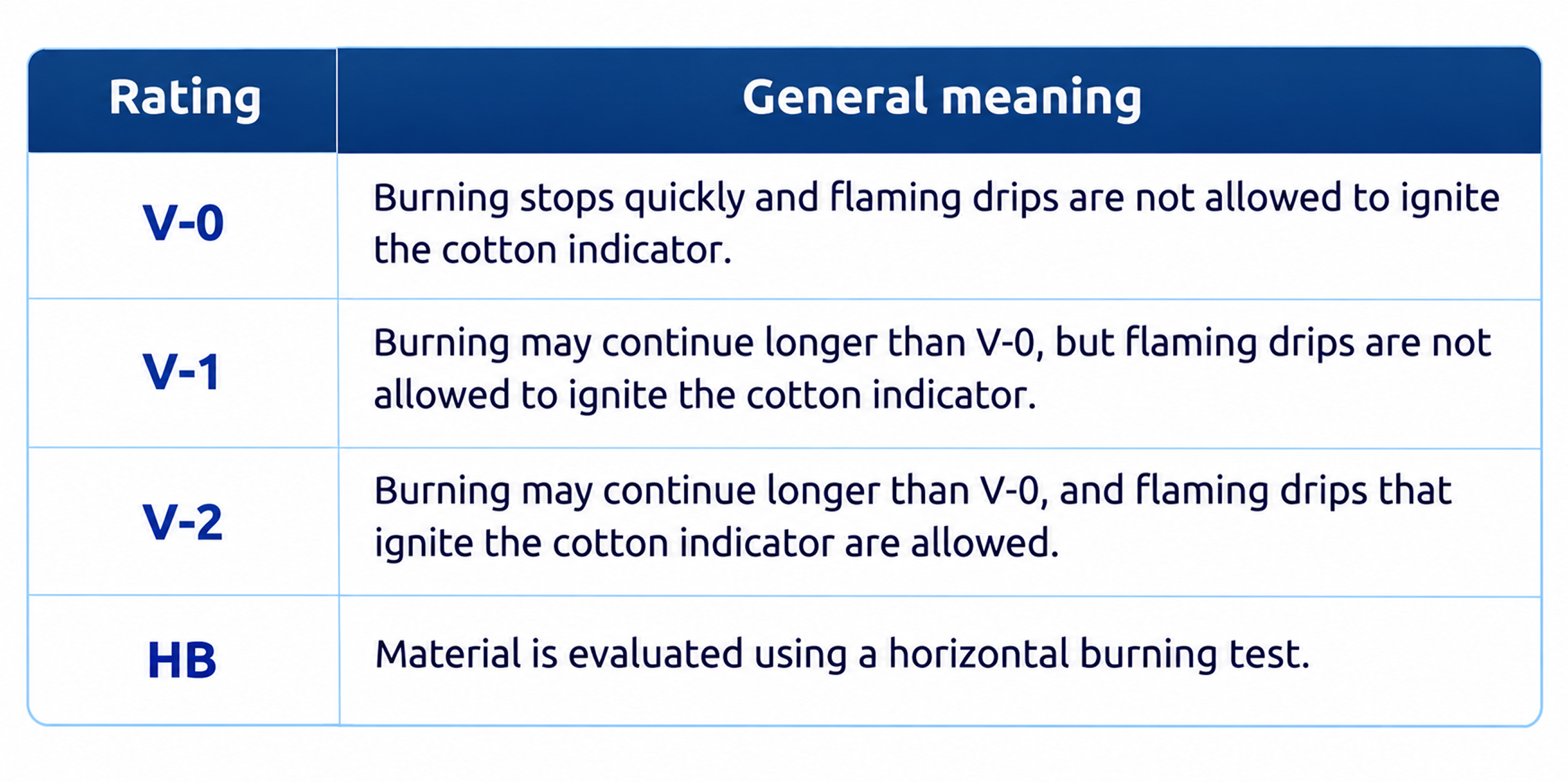
However, a UL 94 rating should not be treated as a complete certification of the finished product.
The final product may have additional requirements based on its design, thickness, construction, electrical system, and the applicable end-product standard.
One of the most important points when selecting FR-ABS is part thickness.
A material may achieve a particular UL 94 rating at one thickness but not at a thinner section.
For example, a grade recognized as V-0 at 3.0 mm should not automatically be assumed to be V-0 at 1.5 mm.
When reviewing a material, check:
This becomes especially important for thin-wall housings and components where material thickness varies across the part.
A flame rating is important, but it does not tell you how the material will behave during molding or in the finished component.
FR additives can change the mechanical behavior of ABS.
Depending on the application, check:
This is particularly important for housings, clips, snap-fits, brackets, and parts that may experience drops or repeated assembly.
The material needs to withstand the temperature experienced during use.
Two commonly reviewed properties are:
HDT (Heat Deflection Temperature): Indicates how a material behaves under heat and a specified load.
RTI (Relative Thermal Index): Indicates the temperature at which the material can maintain certain properties over longer-term thermal exposure under the relevant UL evaluation.
These values should be compared with the actual operating conditions of the part.
For electrical and electronic applications, additional properties may be important.
These can include:
The right requirements depend on the application and applicable product standard.
A material can meet the required flame rating and still create processing problems.
Before approving a grade, review
Processing conditions should be validated using the actual machine, mold, and part design.
For visible components, appearance can be just as important as technical performance.
Check:
The exact grade and formulation should remain consistent during qualification and regular production.
FR-ABS is not always the best choice for every application. FR-PC/ABS blends are another option when higher performance is required.
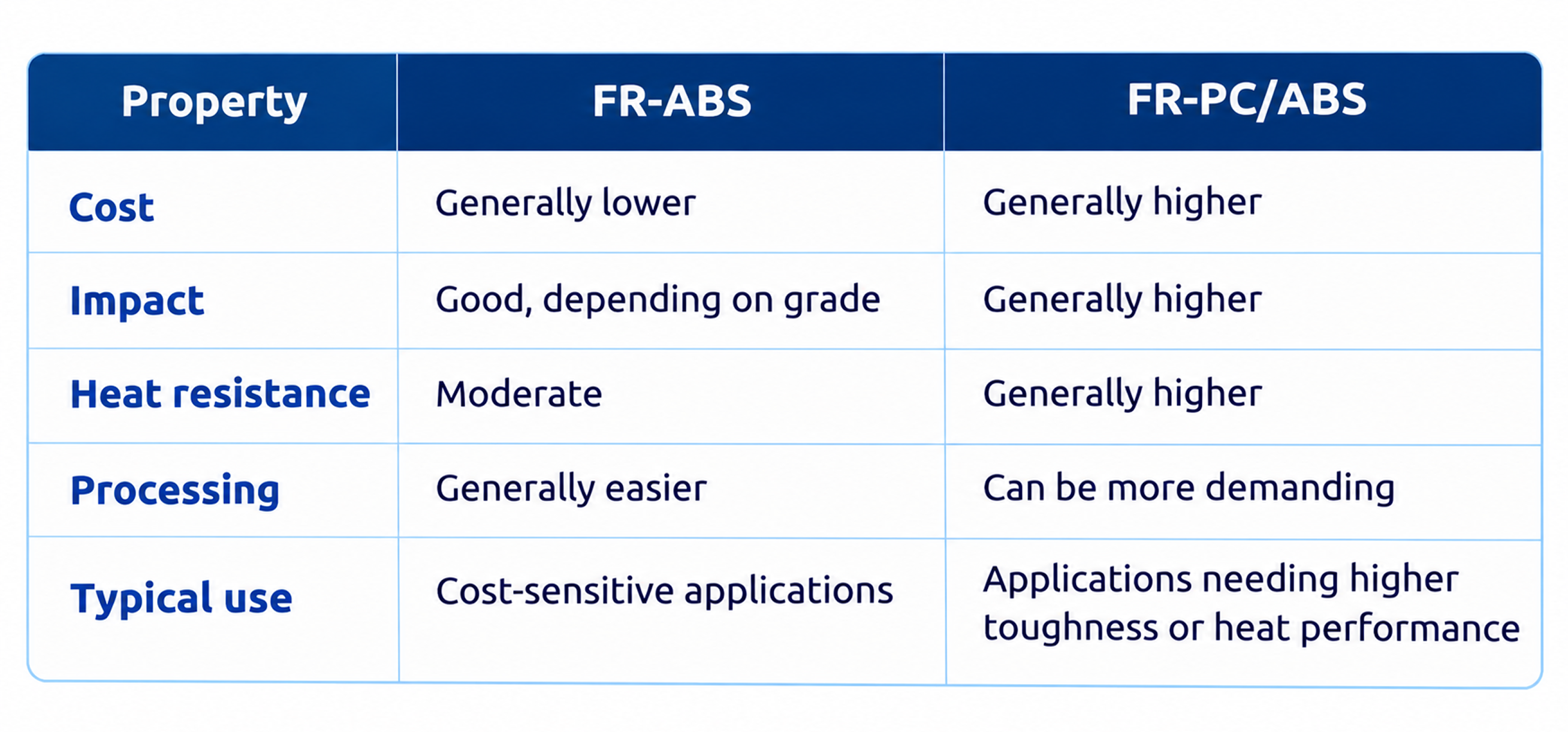
FR-ABS can be a good choice when cost, appearance, flow, and moderate performance are important.
FR-PC/ABS may be considered when the application requires higher impact performance or greater temperature resistance.
The final decision should always be based on the specific grades being compared rather than the polymer family alone.
FR-ABS is commonly considered for applications such as:
The suitability of FR-ABS depends on the required flame rating, wall thickness, temperature, mechanical performance, electrical requirements, and applicable product standards.
Material selection should start with the finished component, not just the resin datasheet.
Identify the required UL 94 rating and the minimum wall thickness of the part.
Do not select a grade based on the V-0 label alone.
Identify the properties that matter for the application:
Not every application needs the same combination of properties.
Confirm that the grade can be processed using the available equipment and mold.
Review drying, temperature, melt flow, and processing recommendations before production trials.
Depending on the application and customer requirements, check documentation related to:
Some flame-retardant formulations may use fluoropolymers such as PTFE as anti-dripping aids. Where PFAS-related requirements apply, review the complete formulation and supplier documentation rather than making assumptions based only on the product name.
A material that looks suitable on paper still needs to be tested on the actual component.
Check molding performance, appearance, dimensional stability, mechanical performance, and required flammability performance before final approval.
No. UL 94 V-0 only describes the material’s flammability performance under specific test conditions. The grade should also meet the required wall thickness, mechanical, thermal, electrical, processing, and regulatory requirements of the application.
Yes. A material can have different UL 94 performance at different thicknesses. Always check the tested thickness for the exact grade before approving the material.
FR-ABS contains flame-retardant additives that help slow burning and stop the material from continuing to burn after the flame source is removed. These additives can also affect properties such as impact strength, flow, density, and processing.
At minimum, check the UL 94 rating, minimum thickness, MFR/MFI, impact strength, heat resistance, processing conditions, density, and required compliance documents.
Standard ABS is generally not ideal for long-term outdoor exposure because UV exposure can affect its performance over time. For outdoor applications, UV-stabilized ABS, ASA, or PC/ASA may be considered depending on the requirements.
Not necessarily. The required rating depends on the application. A V-0 grade may have different mechanical, processing, thermal, or cost characteristics than another grade. The best material is the one that meets all the requirements of the finished part.
Yes. Two grades can have the same flame rating but different impact strength, melt flow, heat resistance, appearance, processing behavior, and cost.
A lower material price can be offset by higher rejection, processing issues, longer cycle times, additional testing, or requalification. The better comparison is the total cost of using the material, not just its purchase price.
Ask for the technical datasheet, UL recognition information, processing guidelines, compliance documentation, and relevant test data. Also confirm that the exact grade and color being supplied match the material that was qualified.
Test the material using the actual component and production process. Check molding performance, appearance, dimensions, mechanical performance, and required flammability performance before final approval.
Match your process and performance needs to the right resin grade.
For formulation details, reach out to polymers@distil.market.

READ MORE


READ MORE
READ MORE
READ MORE
READ MORE
READ MORE
READ MORE
READ MORE
READ MORE
READ MORE
READ MORE
READ MORE

READ MORE
READ MORE
READ MORE
READ MORE
READ MORE
READ MORE
READ MORE
READ MORE
READ MORE
READ MORE
READ MORE

READ MORE
READ MORE

READ MORE

We enable global brands to diversify production and accelerate sustainable sourcing while protecting IP.
Corporate Presentation
Follow us


© 2026 Distil. All rights reserved.


