A backup resin is not simply another material with similar Technical Data Sheet (TDS) values. For a backup to be useful, it needs to meet the requirements of the application, run reliably on the intended process, produce acceptable parts, and satisfy relevant quality, customer, and supply requirements.
The objective is therefore not to qualify every resin in your portfolio. It is to identify the grades where supply disruption would have the greatest business impact and qualify viable alternatives before time pressure makes the decision difficult.
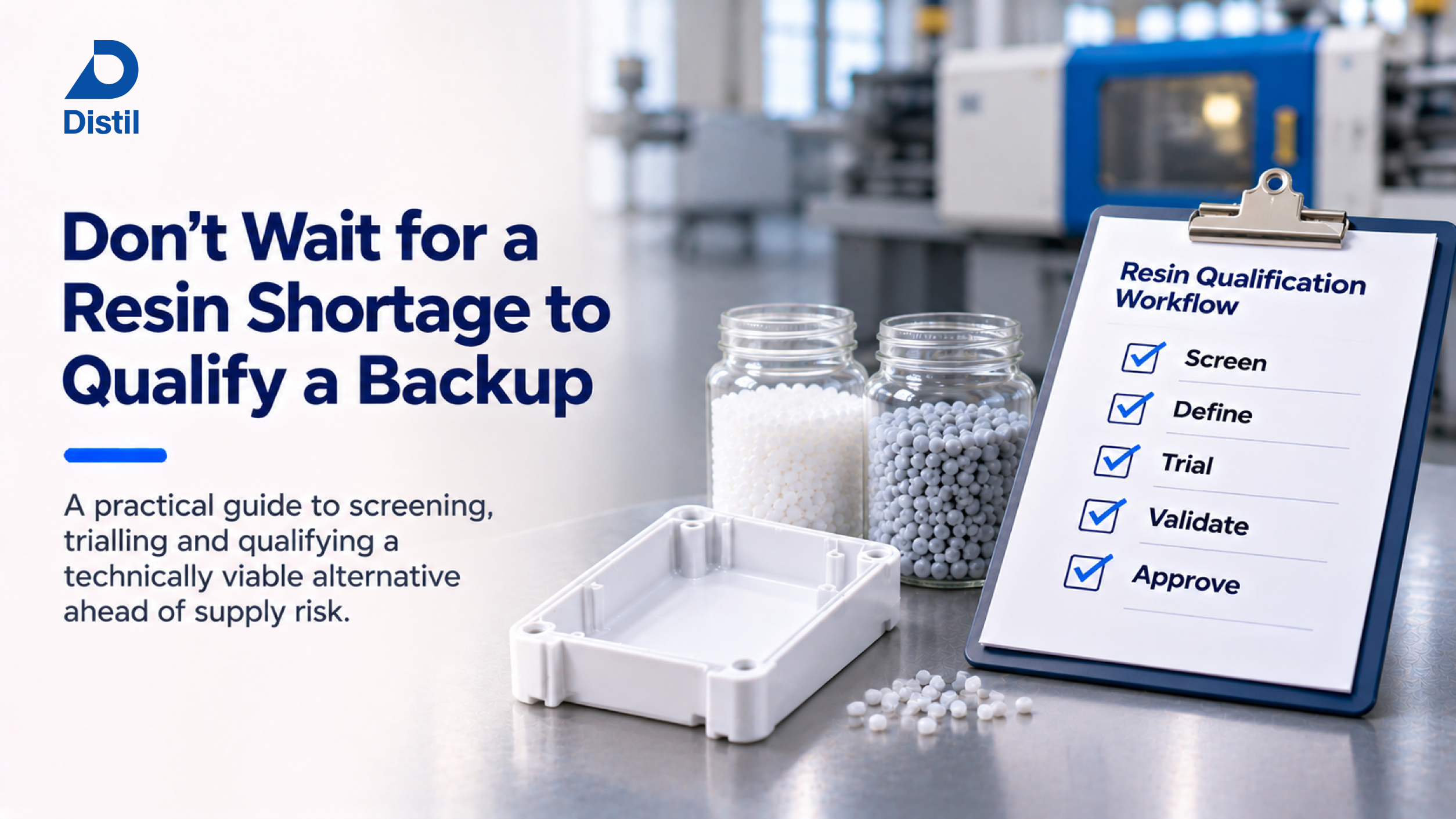
Not every polymer grade requires a backup. Start with grades where the combination of production dependency, supply risk, switching difficulty, and consequence of failure is high. When evaluating alternatives, look beyond unit price (₹/kg) and headline TDS values to assess fit across Material, Process, Part, and Supply. A structured qualification workflow—Screen, Define, Trial, Validate, Approve—helps turn a potential alternative into a verified option for the intended application.
Qualifying every resin in your bill of materials can consume trial capacity, engineering time, and resources. Start with grades where a supply disruption could have a significant operational or commercial impact.
Consider:
A single-source resin is not automatically a high-risk material, just as having multiple suppliers does not automatically provide a qualified backup. The key is to assess the overall business and technical risk associated with changing the material.
When supply becomes constrained, teams may have to make material decisions under time pressure. That can reduce the time available for controlled trials, process optimization, quality checks, and required approvals.
Qualifying an alternative in advance gives technical teams time to establish suitable processing conditions and compare the candidate against the existing grade under realistic production conditions.
It also gives procurement a clearer understanding of what can actually be switched, rather than discovering during a shortage that a theoretically similar material still requires significant technical or customer approval.
A planned qualification process is therefore:
Screen → Define → Trial → Validate → Approve
rather than:
Shortage → Urgent Trial → Production Decision
A lower resin price does not necessarily mean a lower cost of production.
A material with a lower purchase price can still increase production costs through higher scrap, longer cycle times, additional processing adjustments, inconsistent appearance, or rejected parts.
When comparing alternatives, evaluate the material across four practical areas:
Area
What to Evaluate
Material
Grade intent, melt flow behavior, moisture sensitivity, additive/stabilizer package, required specifications, and customer or regulatory requirements.
Process
Machine compatibility, drying or preconditioning requirements, processing window, cycle time impact, and regrind requirements.
Part
Dimensional stability, shrinkage and warpage, surface finish, appearance, mechanical performance, and application-specific requirements.
Supply
Supplier reliability, lead-time stability, batch-to-batch consistency, documentation, traceability, and commercial terms.
The objective is to understand the total cost and risk of using the material, not just its purchase price.
Two resins with similar TDS values can still behave differently in a specific manufacturing process.
Comparable melt flow, tensile strength, or impact values do not fully describe how a material will interact with a particular machine, tool, part geometry, processing condition, or production environment.
Standardized laboratory data is therefore an important screening tool—but it should not be treated as proof of production equivalence.
A stronger qualification process includes five steps.
Compare the candidate against the existing grade's technical requirements, application needs, customer specifications, and applicable compliance requirements.
Before the trial, establish the acceptance criteria.
These may include:
Defining these criteria before the trial helps ensure that the candidate is evaluated against agreed requirements rather than subjective observations.
Run the candidate on the intended production equipment using controlled and documented conditions.
Compare the candidate with the existing material while monitoring relevant process and production indicators.
Evaluate the resulting parts against the predefined acceptance criteria.
Depending on the application, this may include dimensional checks, visual inspection, mechanical testing, functional testing, process stability, and production consistency.
Document the qualification results and obtain the required internal and customer approvals before commercial use.
The result should be more than a matching data sheet. It should be a verified material option for a defined application and process.
A pre-qualified alternative gives procurement more flexibility when supply conditions change.
Supply resilience
If the primary supplier experiences delays, allocation issues, or capacity constraints, a qualified alternative can provide another supply path without starting the technical evaluation from zero.
Commercial flexibility
A technically proven alternative gives procurement a stronger position in supplier discussions because the option has already been evaluated rather than simply identified from a supplier list.
Demand flexibility
When demand increases or supply becomes uneven, qualified alternatives can help distribute supply risk where the application and approvals allow it.
The value of a second source is therefore not simply having another supplier's name in the system. It is having an alternative that has already been evaluated against the requirements of the application.
A material that is qualified today should not automatically be considered permanently interchangeable.
Changes in formulation, raw-material sources, manufacturing locations, processing recommendations, specifications, or supplier processes can affect material performance.
For critical grades, qualification should therefore be supported by appropriate supplier monitoring and change-control practices.
This helps ensure that the alternative remains suitable as the material, supplier, or application evolves.
No. Start with grades where the combination of production dependency, supply risk, switching difficulty, and consequence of failure is high.
Supply disruptions can reduce the time available for proper trials, process adjustments, validation, and approvals. Early qualification gives teams more time to evaluate an alternative under controlled conditions.
No. TDS data is an important starting point, but production qualification should also consider processing behavior, part performance, quality requirements, and application-specific specifications.
Look at the overall cost and risk of using the material, including scrap, cycle time, consistency, lead time, documentation, qualification requirements, and supply reliability.
Compare the candidate against predefined acceptance criteria for processing stability, cycle time, part dimensions, appearance, mechanical or functional performance, scrap rate, and other application-specific requirements.
The required approval team depends on the application. Procurement, Technical, Quality, Engineering, and relevant customer-facing teams may all have a role. Customer or regulatory approval may also be required for specific applications.
Not necessarily. Supplier changes, formulation changes, manufacturing-site changes, specifications, or application requirements can trigger a new review or requalification.
It gives your organization a technically evaluated option that can be considered when supply tightens, demand changes, or the primary supply route becomes less reliable.
Managing critical or single-sourced resin grades?
Distil can support your team in identifying technically viable alternatives, comparing grades, and supporting structured trials before supply disruption becomes urgent.
Reach out to polymers@distil.market
READ MORE


READ MORE
READ MORE
READ MORE
READ MORE
READ MORE
READ MORE
READ MORE

READ MORE
READ MORE
READ MORE
READ MORE

READ MORE
READ MORE
READ MORE
READ MORE
READ MORE
READ MORE
READ MORE
READ MORE

READ MORE
READ MORE

READ MORE
READ MORE
READ MORE

READ MORE

We enable global brands to diversify production and accelerate sustainable sourcing while protecting IP.
Corporate Presentation
Follow us


© 2026 Distil. All rights reserved.


