
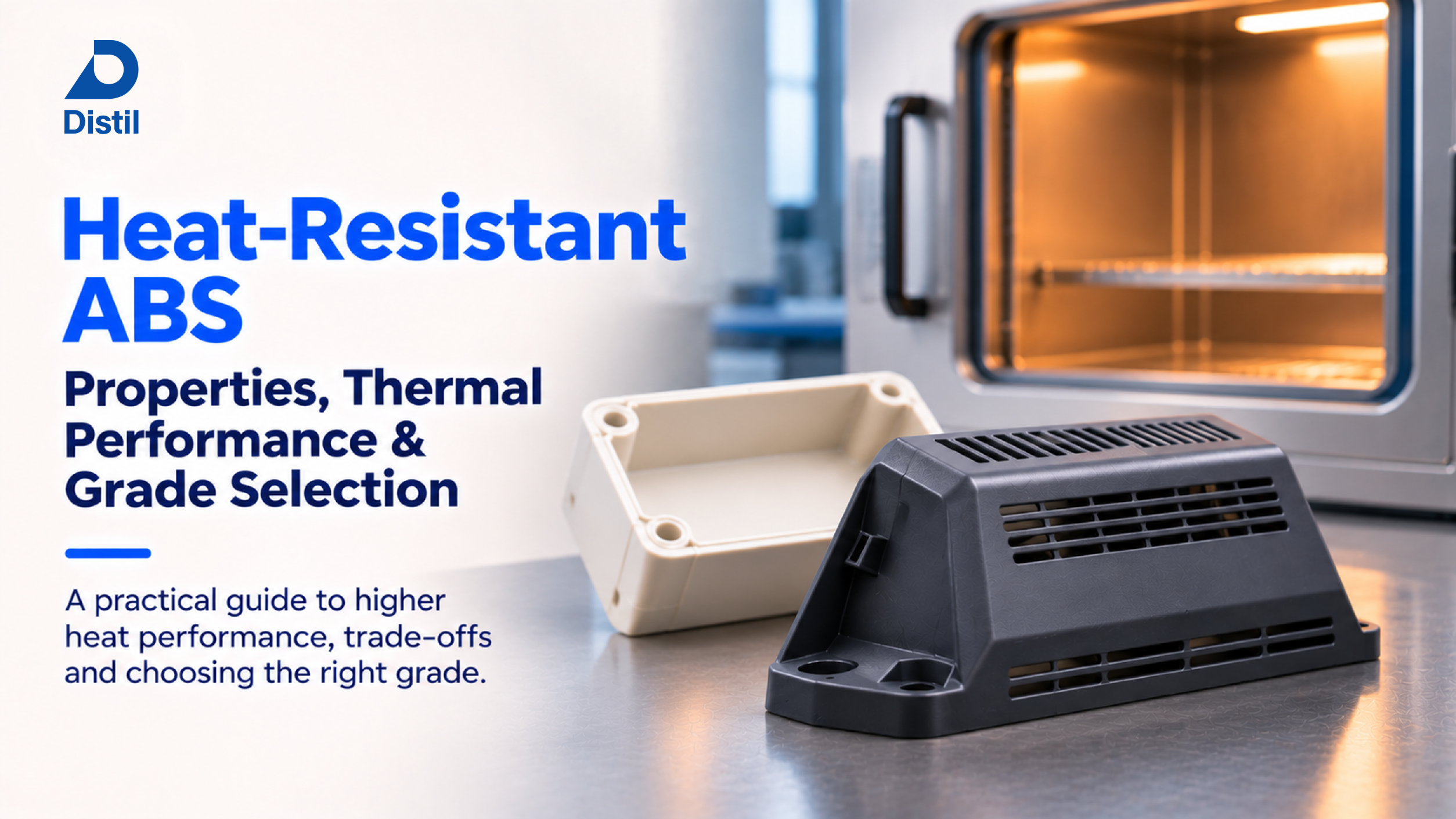
Standard ABS offers a good balance of toughness, rigidity, surface quality and processability, making it widely used across consumer, automotive, electrical and industrial applications.
However, standard ABS can become thermally limited when a component is exposed to sustained heat or mechanical loading at elevated temperatures. Heat-resistant ABS grades are designed to provide higher thermal performance while retaining many of the processing and cost advantages of ABS.
Selecting the right grade, however, requires more than comparing HDT values. Thermal performance must be considered alongside impact strength, flow behaviour, part geometry, flame retardancy and application requirements.
ABS consists broadly of a styrene-acrylonitrile (SAN) matrix containing a dispersed rubber phase.
Each component contributes to the overall performance of the material:
Heat-resistant ABS is developed by modifying the polymer structure or combining ABS with other engineering polymers to increase thermal performance.
α-Methylstyrene (AMS) can be incorporated into the styrenic polymer system to increase the heat resistance of the rigid phase.
AMS-based systems are commonly used in high-heat ABS grades, with the final performance depending on the specific formulation.
N-Phenylmaleimide (PMI) is another approach used to increase the thermal resistance of styrenic materials.
PMI-based systems can provide higher heat resistance than many conventional high-heat ABS grades, although impact strength, flow and processing behaviour depend on the formulation.
ABS can also be blended with higher-performance polymers such as polycarbonate.
PC/ABS blends can provide a combination of heat resistance, impact performance, processability and flame-retardant options, depending on the grade.
The following comparison is a general selection guide. Actual properties vary by grade and formulation.
PropertyStandard ABSHeat-Resistant ABSHigher-Heat ABSPC/ABSHeat resistanceModerateHigherVery high, depending on gradeHigh to very highImpact strengthGenerally goodGrade-dependentGrade-dependentOften very goodLow-temperature impactGenerally goodGrade-dependentGrade-dependentOften strongProcessingGenerally straightforwardGrade-specificMore grade-specificGrade-specificFlame-retardant optionsAvailableAvailableAvailableWidely availableRelative costLowerHigherHigherGenerally higherTypical selection driverBalanced performance + costIncreased heat resistanceHigher thermal requirementsHeat + impact + engineering performance
Important: Always compare actual supplier datasheets using the same test methods and conditions.
HDT measures how a plastic specimen deforms under a specified load as temperature increases.
It is useful for comparing the short-term thermal stiffness of different materials.
However, HDT should not be treated as the maximum continuous service temperature of a finished component.
Actual performance depends on temperature, load, exposure time, geometry and processing history.
Vicat measures the temperature at which a thermoplastic begins to soften under a defined penetration force.
It can be useful for comparing softening behaviour between grades, but it does not represent how a finished component will behave under real mechanical loading.
When comparing materials, make sure the same test method is being used.
RTI is used to evaluate long-term thermal ageing and retention of specified material properties.
For electrical and electronic applications, RTI can be an important consideration alongside UL certification requirements.
It should not, however, be treated as a universal maximum operating temperature.
Higher heat resistance can change other material properties. This is why selecting the grade with the highest thermal rating is not always the best solution.
Increasing heat resistance can affect impact performance, particularly at lower temperatures.
If a component requires both high heat resistance and strong impact performance, evaluate the actual grade for both requirements rather than selecting based on HDT alone.
Depending on the application, options may include specially formulated high-heat ABS, PMI-modified systems or PC/ABS blends.
High-heat ABS grades can have different melt-flow characteristics from standard ABS.
However, higher heat resistance does not automatically mean lower MFR or higher melt viscosity.
For moulding applications, consider:
The supplier's processing recommendations should be the starting point for process development.
Material selection alone does not determine dimensional stability.
Uneven wall thickness, sharp corners, abrupt section changes and inappropriate rib design can increase residual stress and differential shrinkage.
When a molded part is exposed to heat, these stresses can relax and contribute to:
Good part design and controlled molding conditions are therefore important alongside resin selection.
ABS generally offers useful resistance to many common chemicals, but compatibility depends on the chemical, concentration, temperature, exposure time and material formulation.
Elevated temperature and mechanical stress can increase the risk of environmental stress cracking.
For demanding applications, chemical compatibility should be validated under actual operating conditions.
Heat-resistant ABS can be considered for applications such as:
Selection may depend on heat exposure, dimensional stability, impact performance, appearance and applicable OEM requirements.
Potential applications include:
In these applications, heat resistance may need to be evaluated alongside UL 94, RTI and electrical requirements.
Heat-resistant ABS can be considered for selected:
Components exposed directly to substantially higher temperatures may require other engineering polymers.
Applications can include:
Start with the actual application.
Identify:
Separate short-term peak exposure from long-term operating conditions.
Consider:
For parts with snap-fits, clips, bosses or structural features, evaluate performance under the actual expected load.
Consider MFR together with:
Thin-wall or long-flow applications may require a higher-flow grade, but the highest-MFR grade is not automatically the best choice.
If flame retardancy is required, specify the required:
Do not assume that an FR ABS grade will retain the same thermal or mechanical performance as a non-FR grade.
Depending on the application and market, verify requirements such as:
Compliance is grade-specific, not simply resin-family-specific.
Choose heat-resistant ABS when you need higher thermal performance with a good balance of cost, processability and mechanical properties. PC/ABS may be preferable when higher impact strength or broader engineering performance is required.
No. A higher HDT does not automatically mean better overall performance. Impact strength, flow, processing requirements and application conditions must also be considered.
No. HDT is a short-term comparative test under defined conditions and should not be treated as the maximum operating temperature of a finished part.
Annealing can reduce molded-in stress and improve dimensional stability, but it does not fundamentally change the polymer's inherent heat resistance.
Drying conditions vary by grade and equipment. Always follow the resin supplier's recommended drying temperature and time.
Flame-retardant additives can affect HDT, impact strength, flow and processing behaviour. Select a grade specifically tested for both heat resistance and the required UL 94 rating.
Compare HDT, impact strength, MFR, processing conditions, shrinkage, flame retardancy and certifications—not just the resin price.
Match your process and performance needs to the right resin grade.
For formulation details, reach out to polymers@distil.market.
READ MORE


READ MORE
READ MORE
READ MORE
READ MORE
READ MORE
READ MORE
READ MORE
READ MORE
READ MORE
READ MORE

READ MORE

READ MORE
READ MORE
READ MORE
READ MORE
READ MORE
READ MORE
READ MORE
READ MORE
READ MORE
READ MORE
READ MORE

READ MORE
READ MORE

READ MORE

We enable global brands to diversify production and accelerate sustainable sourcing while protecting IP.
Corporate Presentation
Follow us


© 2026 Distil. All rights reserved.


